Showing posts with label History. Show all posts

Monday, May 21, 2007

A good quote

Just have to note this, if for no one else but myself:

A prime test of an historian’s skill is the extent to which he does justice to these complementary forces, repetition and novelty.


From this article, by Roger Kimball.

Friday, December 29, 2006

Top Ten Cool Things of the Year (in the U.S.)

This wasn't such a great year. The situation in Iraq deteriorated even more, and yet OJ Simpson's absurd book seemed to generate more outrage among some--namely the over employed entertainment media. So, what was great about 2006? Not a whole lot. Doing my best to remember what on earth happened this year, I'll try to extract the few cool things that did happen, in no particular order:

1. Stephen Colbert at the Annual White House Correspondents Dinner: In May, Colbert helped draw attention to an event that usually serves as a bad inside joke for a few hundred people by humorously critcizing the president's famous ego. He mocked Bush's supposed steely resolve--"Events can change; this man's beliefs never will"--cutting it down to the publicity stunt it is:

I stand by this man. I stand by this man because he stands for things. Not only for things, he stands on things. Things like aircraft carriers, and rubble, and recently flooded city squares. And that sends a strong message: that no matter what happens to America, she will always rebound—with the most powerfully staged photo ops in the world.


Not only was Colbert's bit itself hilarious, but it became a watershed media event. YouTube, 2006's ubiquitous website, proved especially useful in the days after the event, allowing people to access what really went down at the dinner rather than taking the mainstream media's word for it. Their word was often non-existent, because many outlets initially determined the event not newsworthy--including The New York Times and The Chicago Tribune--despite the ramifications of the event: one of the country's most clever comedians had pointedly skewered one of the most insulated of modern presidents, who was sitting just a few feet away. It should be no surprise then that the second target of Colbert's routine was the lackadaisical media--many in attendance at the dinner--who have so often failed to vigorously question George W. Bush about his agenda:

Over the last five years, you people were so good—over tax cuts, WMD intelligence, the effect of global warming. We Americans didn't want to know, and you had the courtesy not to try to find out. ... And then you write, 'Oh, they're just rearranging the deck chairs on the Titanic.' First of all, that is a terrible metaphor. This administration is not sinking. This administration is soaring. If anything, they are rearranging the deck chairs on the Hindenburg!


The event was remarkable for fusing politics and entertainment for constructive good, for being accessibile to a mass audience, and for serving as a jumping off point for debate about the usefulness of the media. The Colbert performance at the White House Correspondents' Dinner is perhaps the emblematic event of a year of consumer participation in newsmaking.

2. The Democratic Victory in the 2006 Congressional Elections: One can easily imagine the media narrative that would have persisted had the Republicans maintained control of Congress after the November 2006 elections: that Americans were satisfied with the direction of the War in Iraq despite visible reservations, that the economy wasn't bad enough to require a renewed focus on growing inequity--like the recent cuts in student aid and the failure to increase the minimum wage--and that, in general, Americans were satisfied with the Republican social agenda. A wisdom that had prevailed for years changed on November 7.

Up against a gerrymandered Congress, the Democrats still won big in the House. They also managed to eke out victory in the Senate, knocking out some formidable incumbents like George Allen of Virginia and Conrad Burns of Montana. Furthermore, they won with great help from the so-called "liberal bloggers," whose fundraising, organizing, and message generating did justice to the term netroots. The Democrats in 2006 were not the Democrats of 1996, who relied upon the contributions of moneyed coffers and directed most of their energies to retaining the presidency rather than making inroads in Congress.

The new Congress is focusing on a different course in Iraq--though it is still up to the intransigent President to assume one--and on economic issues that were ignored under one-party rule. Plus, the 2006 election was also a victory against apathy, with the number of voters up in the usually less participatory midterm elections. Especially encouraging: 24 percent of Americans 18-30 voted, the largest percentage in 20 years.

3. Harvard, then Princeton and UVA, End Early Decision: In September, Harvard and then Princeton and the University of Virginia moved to end the early admission option, deciding that it favored savvier applicants from more advantaged backgrounds. Although other top schools do not yet see the need to eliminate early decision, Harvard at least brought to attention the need for universities to be attentive to the disparate sophistication of prospective students with the college application process. Although some schools, like my Alma mater Northwestern, have made some reasonable points on why early decision still suits them, it is good for universities to publicly discuss institutional inequities. Hopefully, Harvard and its peers will figure out how better to assist both low income and middle class students with the costs of their education.

4. TV Programming Continues to Improve: Although there is still drek on television--there always will be--some TV programming continues to delight. While I think some of the critics favorite shows, particularly "Weeds" and "Scrubs" are overrated, "The Office," "The Colbert Report," "The Daily Show," and HBO programming continue to shine. "The Office" was rightfully awarded an Emmy for its fantastic ability to find humor in the mundane and for the genuine performances put forth by its cast. After a reportedly bumpy first year, "The Office" figured out how to adeptly adapt the British version to reflect the nature of the American workplace in year two. (Now, there is a French and German version of "The Office," showing that the workplace is a universal source of humor, though not necessarily the same humor). Office romances, career dissatisfaction, narrow-mindedness, and the American work ethic are depicted realistically and hilariously. To think, 10 years ago, the only good things going on network TV were "Frasier," "Friends" (meh) and "Seinfeld," and the sitcom (shudder) reigned supreme. Hopefully, the cool event of 2007 will be that cable companies lose their regional monopolies and prices decrease (I wish).

5. Some Bad People Went to Prison: This year, Jack Abramoff and Jeffrey Skilling, two men who enjoyed far too much power in the 1990s, were convicted to formidable prison terms. Abramoff was convicted of conspiracy to bribe a public official, defrauding a client, and tax evasion, and was sentenced to the minimum of 10-years, in anticipation that he will cooperate with investigations of other corruption cases. He and his lobbying firm contributed to the excess of Republican-controlled Washington. Abramoff was intimately involved with disgraced former majority leader Tom DeLay, who his lobbying firm treated to trips to the North Mariana Islands, and Abramoff himself secretly funded the trips of other Republican Representatives. Abramoff's corruption is too extensive to document here, but concurrent to his demise went the careers of a lot of disgraceful people, including DeLay, Randall "Duke" Cunningham, and Robert Ney.

Jeff Skilling, former CEO of the defunct Enron Corporation might be the person most single-handedly responsible for the California electricity crisis of 2000-2001, in which the state's recently deregulated electricty grid allowed for Enron employees to manipulate the energy markets in there, causing prices to spike and supply to be unevenly distributed. Too bad Skilling can't provide redress for all of the pension plans that were decimated by the Enron collapse as well as for the electricty bills and costs incurred by the state of California during the energy crisis.

6. Immigrant Rallies Across the Nation: Often defined by their demagogic opposition, tens of thousands of immigrants and those in favor of immigrant interests rallied across the nation in April, drawing attention to their contributions and advertising their presence to Congress, which was then considering immigration reform. For a group that fills mostly the least desirable jobs in the country, immigrants get a lot of flack, despite that the United States is a nation of immigrants. A typical complaint against illegal immigrants is that they use up public services, but wouldn't pushing for legalization and thereby getting them to pay into the system be a good way to prevent this? Of course, this would have to be accompanied by pay approximating a living wage...

7. FDA Approves HPV Vaccine and Plan B OTC: The current administration has not wholly succeeded in stymieing progress of its agencies. The FDA approved the Human papillomavirus vaccine and over the counter (OTC) Plan B contraception. Though religious zealots will probably tell you otherwise, there is never anything wrong with vaccinating against a sexually transmitted disease. The idea that it encourages unprotected sex or sex in general is like saying that a flu vaccine encourages not washing one's hands. The approval of Plan B also generated controversy, but it will make an unpleasant process easier to handle for many people.

8. An Inconvenient Truth Brings More Attention to Global Warming: In a year of erratic temperatures and a hostile climate, Al Gore used his influence and celebrity for good, bringing attention to the force behind climate fluctuations. It is amazing that the existence of global warming needs such a forceful defense, even though it is not in scientific dispute, but that is why Gore's contribution was so constructive. Though of course not as watchable as a movie like Casino Royale, Gore does an admirable job of meticulously deconstructing the arguments against global warming and detailing those for it. If parts of our country are submerged under water in the not too distant future, Al Gore can (somberly) say I told you so.

9. Google Buys YouTube: In an acquisition that didn't reek of evil, the search engine giant bought out the user-generated content giant. Not only does YouTube's searchable video content model seem commensurate with Google's model, but Google appears to be an encouraging parent corporation, managing to maintain the integrity and while innovating its other acquisitions, like this here software I'm using. (Meanwhile, the telecom market is consolidated by another dispiriting merger, as AT&T's absorption of Bell South Corp. is approved by the FCC).

10. Bob Woodward's State of Denial Released: The tipping point of popular opinion against George W. Bush must surely have been reached when Bob Woodward--establishment journalist and former Bush administration cheerleader--released State of Denial: Bush at War, Part III. Woodward's book seemed to cement the view that the War in Iraq was a mistake, and that its execution was poorly managed at best, providing an indictment of all of the key actors in the administration who consistently lied and misled over the years to save face.

This was a pretty difficult list to come up with, because this was a pretty difficult year, but I know I'm forgetting things. Please comment with any additional suggestions or any recommended subtractions.

Sunday, December 24, 2006

Apocalypto wasn't accurate?!?!

An article in Salon from Mayan expert Marcello Canuto about Apocalypto--nay--Mel Gibson's Apocalypto and questions over its accuracy:

The movie tracks a young Mayan man who is captured in a surprise raid on his village. Forced to abandon his family, he and his companions are taken to the nearby city to be sacrificed. He manages to escape and, pursued by his captors, attempts to return to his village to save his family. During his getaway, he reaches a beach where he witnesses the arrival of Spaniards.

This final scene tells us that the movie focuses on Maya society on the eve of Spanish contact in the 16th century. Yet the Maya city portrayed in the movie, central to its plot, dates roughly to the 9th century. This is akin to telling a story about English pilgrims founding the Massachusetts Bay Colony, and showing them living in longhouses described in "Beowulf." In fact, Gibson incorporates Maya images from as far back as 300 B.C. Throughout the movie, these anachronisms make Maya civilization seem timeless, and undermine the idea that the Maya could and did respond to change.

Another question I had more about the logistical accuracy of Apocalypto: how did main character Jaguar Paw so quickly and expertly find his way back to his village in the forest of the Yucatan peninsula from the city center? And who is supposed to symbolize Jesus--Jaguar Paw, or his water-birthed child? Also, why was the forest so close to the cornfields as well as the beaches that the Spaniards land on?

Actually, I was disappointed that Apocalypto did not actually tackle head-on the downfall of Mayan civilization, whose supposed causes--pestilence, colonization, depression of trade, slave revolt--are in dispute; however, maybe it's for the best that Mel Gibosn is not the one to do this. As Canuto says of Gibsons enormous inaccuracies:

If there were ever an apocalypse in the history of the Maya -- and herein lies the ultimate demoralizing irony of the movie -- it would be because of European contact. But in the movie, after two hours of excess, hyperbole and hysteria, the Spaniards represent the arrival of sanity to the Maya world. The tacit paternalism is devastating.

Nonetheless, I loved Apocalypto only because it was totally INSANE; and fortunately it has compelled me, as the writer hopes, to look into the real history of Maya civilization rather than trust Mel Gibson.

Friday, November 24, 2006

Review of movie I haven't seen: Bobby

I continue to feel more motivation to review movies that I have not seen than those that I have. Although I have seen a variety of films recently--The Queen, The Rise and Fall of Legs Diamond, Jules et Jim, Network (again)--I only want to review Bobby, the movie about the second most famous Kennedy (or maybe third or fourth). Actually, Bobby is less about Robert F. Kennedy, JFK's brother and once U.S. Attorney General, than it is about the mood of the country when RFK was assassinated in 1968.

Though I am admittedly curious to see this movie, a few of its attributes worry me. First of all, "directed by Emilio Estevez" is not particularly encouraging. The Post says Estevez is "best known" as one of the "Brat Pack" actors, but among members of my generation, it's much worse: he's Coach Gordon Bombay of The Mighty Ducks and D2. He has said, "Quack, quack, quack, Mr. Duckworth!" in a movie. He is a poor man's Charlie Sheen (who happens to be his brother). Just to clarify, his dad is Martin Sheen, and he had to play a hockey coach in a stupid (but admittedly hilarious) kids movie!

Secondly, the cast aims to be an exciting ensemble and as such includes one-note actors like Helen Hunt, Lindsay Lohan, Ashton Kutcher, and Heather Graham. A film that aims to create an aura around a consequential historical figure totally does itself in if it casts Ashton Kutcher in any role, even as an extra. As for Heather Graham, I was not aware that she was still around, but she has the honor of being my least favorite actress of all time. Her over-acting ditz schtick made the sequel to Austin Powers exponentially worse than it already was, and she looks like an albino bug.

Finally, and most importantly, from all accounts, Bobby is based upon the premise that Bobby Kennedy was a good guy. That is not to say that the film is incorrect to portray him as a figure who inspired, because he did, especially in the mounting turbulence of 1968, but it adds nothing new to the popular historical picture of Bobby Kennedy, which, as tends to be the case with historical figures, is not a very multi-faceted picture. To his credit, he visited Appalachia to bring attention to the plight of the impoverished, and he became a voice of calm in the early throes of instability in Vietnam, but he was also the legislative aide to Joseph McCarthy during the opportunistic witchhunts of the late 1940s and the early 1950s, and he was, by all accounts, a ruthless operative bent on enforcing loyalty to himself and his brother. He also gave written approval to the FBI to wiretap Martin Luther King, Jr., who the discredited J. Edgar Hoover suspected as a Communist, though in fairness, Kennedy also leant support to the enforcement of Brown v. Board of Education and worked hard to desegregate the government. I can certainly see how it would be interesting for a film to explore how a U.S. politician impacted the American people--I often wonder how consequential political figures are upon peoples' day-to-day experiences--but the portrayal of this oft-recounted historical moment risks bringing nothing new to the table.

Sunday, July 02, 2006

Why History is a major Major

On graduation day a few weeks ago, some of my fellow history majors and I mused a bit about the way our convocation ceremony was organized, with each department lumped in their own section. Right then I felt a history major's pride swelling up, a pride that is pretty much recognized only by a fellow history major, because the non-major who inquires about our area of study is (amazingly) far from moved to regard us in awe. Instead, upon learning of our major, he will form a quizzical expression, pause for a couple seconds, and then finally reconcile himself to our real intentions: "oh, you must want to teach," we are knowingly told.

Even (and perhaps especially) for those who do want to teach, the history major who loves his studies does so because history accounts for every other area of study that is offered at the university. Physics, for instance is not an immortal field (not that it's not important, useful, and incredibly interesting); rather, its existence can be accounted for by human experience, by the advancing interest that humans had in the last five hundred years in the ability to explain and quantify physical phenomena.

Lining up for convocation, one of my history friends even half-joked that political science isn't a real major, an ironic statement given that history and poli sci people are often lumped together, because both majors study similar events and they both produce graduates who tend to go to law school. However, in certain ways, the two are fundamentally opposed: where the study of poli sci--like economics--suggests that there is a science to human behavior that repeats itself, the study of history acknowledges that this is not the case, that in each period of time, an event that may have seemed similar to past events yielded from different actors, motivations, circumstances, and so forth. We might believe that Iraq is not another Vietnam, though we can understand how it is a failed mission just as Vietnam was. We might believe that George W. Bush is not another Richard Nixon, even though they are both guilty of similar indiscretions.

So that, in sum, is why a history major may think s/he is special: there is no immortal explanation for events--not that there aren't lessons to be learned from the past--but rather just human experiences that have preceded us and will follow us. So, though it may annoy you to read this smug proclamation that our major represents an all-encompassing area of study, if it makes you feel better, the other majors usually get the higher paying jobs. ;-)

Wednesday, May 31, 2006

New Wave Punk...Versailles...Running Aristocrats...Sofia Coppola's Marie-Antoinette

There's not a whole lot I can say about the film Marie-Antoinette that has not been said by film reviewers who have already seen the movie. It got "lusty boos" at the Cannes Film Festival and is described by the New York Times reviews that I have linked to as a gilded Versailles presented through a gilded conduit of one bred in Hollywood (not to mention that the soundtrack includes the likes of The Cure and New Order). According to reviewer Manohla Dargis, "Ms. Coppola's period film, which is playing in competition, conceives of her as something of a poor little rich girl, a kind of Paris Hilton of the House of Bourbon."

Reviewer A.O. Scott also sees Marie-Antoinette as "Holding a mirror up to Hollywood." Maybe there is something to the idea that Hollywood has an eerie similarity to Versailles--the frivolity, the unmitigated decadence, the navel-gazing--but it seems like Coppola is too enamored with the ritualistic luxury that surrounded and pampered Marie-Antoinette to realize this. As James Rocchi says, "Much of Coppola's film is given over to sequences of dancing, trying on clothes or relaxing -- all of which may have been important elements of Marie Antoinette's life, but they hardly make for thrilling cinema." I would add that it hardly makes for relevant cinema.

The problem with portraying Marie-Antoinette in this manner is that it neglects that her significance lay primarily in the severe contrast between her (and others at the Court of Versailles's) lifestyle and those of most other French people at the time. Coppola's approach adds yet another uncritical piece of celebrity worship to an already overflowing mass. Perhaps Coppola is so accustomed to the attention she and fellow celebrities get from the press just for being celebrities that, in her mind, the peasants storming Versailles would have been just as enamored with Marie-Antoinette's life as the average American supposedly is with the life of her and her colleagues in the equally insulated and disconnected world of Hollywood. They're not really storming the palace to overturn a social order, they're storming the palace for autographs, right?

Wednesday, April 12, 2006

Thesis Abstract

I just thought I would post my thesis abstract up here because, well I made one, and it's due in three weeks I think, and I don't feel like writing something new. So here it is in all of its glory (not really):

Une Nouvelle Littérature Américaine:

French Readings of American Literature in the Interwar Years

Between the early 1920s and the mid-1930s, articles appeared in French journals heralding the arrival of a new American literature. Written by prominent French intellectuals, these commentaries almost uniformly concluded that certain works of the American realist school of literature by authors including Willa Cather, Theodore Dreiser, John Dos Passos, and Sinclair Lewis, provided a window into the soul of American life. They simultaneously insisted that American culture was on a decline because of its captivity to mass preferences. As a result, these French intellectuals concluded that many of the best American authors expatriated to Europe where they could take advantage of an atmosphere of individualism of which they were deprived living in the United States. Such analysis evoked—whether inadvertently or not—dissatisfaction among French intellectuals over their political relations with America and worry about its seemingly unmitigated postwar industrial expansion and financial hegemony. At the same time, a number of books on the subject of Franco-American relations which expressed the same concerns over American prosperity and greed, Puritanism, philistinism, and conformity, were published. The French intellectual commentary on American literature fit right into this larger dialogue. In identifying American literature’s pessimism about the country’s future, interpreting the novels as a true representation of American life, and linking the creation of American literature to the setting of France and French literary traditions, French engagement with American literature reflected an effort to assert France’s cultural dominance at a time of growing anxiety over American political and economic dominance.

The thing is, I don't think I've figured out anything new, except maybe incorporating the French American literature into the larger Franco-American relationship of the interwar years. Oh well, it's been a good experience.

Saturday, April 08, 2006

An historical moment: the rise of political blogs

I am thoroughly enjoying Bill McKibben's review of Crashing the Gate: Netroots, Grassroots, and the Rise of People-Powered Politics by bloggers Jerome Armstrong (of My DD) and Markos Moulitsas Zúniga (of the Daily Kos). McKibben's review provides an historic overview of the internet's affect on politics in the United States, which must by any measures be understood as monumental. Take as an example the Democratic Senatorial primary challenge in Connecticut that is being waged by Ned Lamont. Not only have blogs like The Daily Kos consistently drummed up support and financial contributions for Lamont (I myself made a small donation to the campaign), but these blogs also began the drumbeat for change in Connecticut in view of current-Senator Joseph Lieberman's unbelievable unwillingness to challenge George W. Bush or to change his position on supporting Bush's Iraq War.

According to McKibben, such blogger-driven influence emerged when the Presidential campaign of Vermont governor Howard Dean coincided with and picked up on the voices of regular Americans in 2003, a movement that, as McKibben says, "rose in the shadows of the Bush ascendancy in the years following September 11, when very few people—certainly not presidential candidates with an eye to getting elected—were willing to challenge the White House directly." These voices were coming especially from the web, where Americans were logging on to connect with their fellow citizens who shared similar sentiments but were scattered across the country. The internet bridged this geographic divide and therefore created a new, people-powered movement. As McKibben says:
the Dean campaign also launched the Internet era in American politics. Previously, even if people became excited about a candidate in the primaries, there wasn't all that much they could do to help. They might find a mailing address and send a check, or wait for the primary campaign to reach their state so they could take part in the campaign and then vote. But Dean's young campaign staff opened a new channel through their Web site Deanforamerica.com, which featured the then still fresh idea of a blog.
...Most important of all, they pioneered on-line money-raising. Every time something unusual happened (when some pundit would disparage the "kiddie corps" running the Dean show, say) the Web site staffers would "put up a bat" on the home page—a picture of a baseball bat, empty like a United Way thermometer in front of a town hall, which they would fill with red as the contributions would come in from people taking a few minutes to read the blog from their home or office computers. The supporters of the Dean campaign easily raised more money than their opponents in the early primaries and caucuses, and for the first time in recent political history, they did it largely with $20 and $50 and $75 contributions from across a large base of his ardent fans.

Such influence was acknowledged in an April 2 article in the New York Times about the internet's influence on politics and campaigning. Most encouraging, perhaps is the threat that web use brings to the television campaign ad, what has morphed into one of the most deplorable and methods of vote-getting because of how wellthe television medium facilitates half-truths and fear-mongering:
Analysts say the campaign television advertisement, already diminishing in influence with the proliferation of cable stations, faces new challenges as campaigns experiment with technology that allows direct messaging to more specific audiences, and through unconventional means.

Of course, the internet has brought with it certain ills too, from shadowy kiddie porn rings to well shadowy bestiality rings, but the success of blogs like those of Jerome Armstrong's and Markos Moulitsas's is encouraging when one thinks back to the helpless and depressed state many of us were in six years ago after a bunch of cronies essentially decided the president of the United States instead of looking to the votes of the American people.

Friday, March 24, 2006

The Seventies: When Americans became dumb?

One of the great paradoxes of our age is how the US can be so dimly complacent and so sharply fearful in the same breath.--James Wolcott

On my flight home from Orlando, Florida last night (I was visiting a friend), as I was opening my airplane reading, historian Bruce Schulman's The Seventies: The Great Shift in American Culture, Society, and Politics, the woman in the seat next to me opened a Rush Limbaugh newsletter. Not fully believing my eyes, I glanced over surreptitiously at the articles every so often, only making myself more disgusted as I saw headlines like "Why Joe Wilson is Wrong" and clearly made-up quotes attributed to Bill Clinton and Al Gore (when will Rush get over his obsession with Clinton, anyway?). As a result of forces that have polarized our society, such as commentators like Rush, Bill O'Reilly, and Ann Coulter who get what seems like unlimited airtime to spew their usually unsubstantiated invective, people like me have tuned out of much of what passes for debate within the mainstream media. In a way, I live in a state of denial: I flip past Fox News as fast as possible, I live in a college town where even (most) Republicans scoff at O'Reilly, and I certainly don't meet a "dittohead," a person who listens to Rush and unquestionably accepts what he says as the truth, very often.

As I sat staring at The Seventies, I wondered how the United States has become a land within which two separate worlds exist: an educated, socially liberal world with faith in science and the less educated, socially conservative world with faith in religion. More importantly, how has the latter world become the more influential in politics and culture? In Schulman's book, I found part of my answer. In The Seventies, it is argued that as a result of frustration with the lack of progress of integrationist movements like Martin Luther King Jr.'s Southern Leadership Conference (SLC) and traditional feminist movements like the National Organization for Women (NOW), activits increasingly agitated against American social and political structures that they had once used to try to win equality. As an example, compare then-lawyer Thurgood Marshall's successful efforts in Brown v. Board of Education to prove that legally separate institutions could by definition never be equal circa 1954 to Stokely Carmichael's "black power"movement where he urged "a complete rejection of American society." With this distrust in the ability of America's public structures to achieve equality came a larger distrust in a government that had up to then been relatively successful at achieving its aims since the 1930s: aims of fighting depression, winning a war, and creating prosperity. In the late '60s and early '70s, however, the war in Vietnam and finally Watergate fomented distrust of government not only among minorities and women but among Americans who hadn't felt as disaffected during the civil rights era.

This, however is where things get muddled. Why, for instance, didn't Americans connect Watergate more directly with its perpetrators rather than with the entire federal government, and why didn't it become a lesson against invasvive government and the accumulation of executive power? Well, I believe it was a lesson against these things for awhile, but soon became a justification for Republican power in a contradictory sense: Republicans claimed they were the party against government and therefore were able to accumulate governmental power and do very corrupt things with it. In the meantime, as The Seventies suggests, Americans were looking to individualist experiences to define their being, their meaning. Schulman suggests that with public institutions in question, traditional organizations that fostered civic belonging waned in membership while membership in New Age movements and evangelist religions took off. This is also where Rush Limbaugh, in my view, could gain his following: from a bunch of people desirous to distrust government, to blame all of their problems on forces far from them, and to try and understand societal upheavals today.

In a recently published book called Retro vs. Metro by John Sperling, et al., the thesis is in part that the U.S. is currentlymade up of two distinct, polarized regional political mindsets (the former being the South, Midwest, and Mountain states, the latter the more populous East and West coasts and Great Lakes states): "one traditional and rooted in the past, and one modern and focused on the future." However, there are a few attributes of so-called "Retro" or red-state, suburban sprawl America that are nothing if not anti-traditional. The almost hedonistic belief in doing everything first and foremost to please oneself, the yes, liberal attitude towards our natural resources that come with driving SUVs and H2s and living in areas that are un-walkable, the unhealthy diets that lead to Type 2 diabetes and obesity: this is a red-state America. I'm not saying there aren't Democrats of this lifestyle or Republicans not of it, but that it is almost synonomous with the ideals of the New Right, which are in a nutshell: me, me me. Distrust of education based on an uninformed cynicism towards scientific reason is a fundamental attribute of the New Right and is in part behind our country's low achievement rankings in education (for instance, in 2003, 15-year olds in America finished 24th out of 29th in math and problem solving abilities).
Religion has become the "opiate of the masses" only because there are large segements of the population today who are unwilling to believe anything else. These are the same people who criticize the ideal of diversity, but when they argue that creationism should be taught in schools, they are employing the exact principles that they are purportedly against by suggesting a diversity of "views" must be taught. By appeasing this group of people and shying away from criticizing their lifestyle in fear of being called "elitist" or "liberal" can only lead to further decline in the direction of our country.

Sunday, February 26, 2006

My final (?) opinion on Nixon


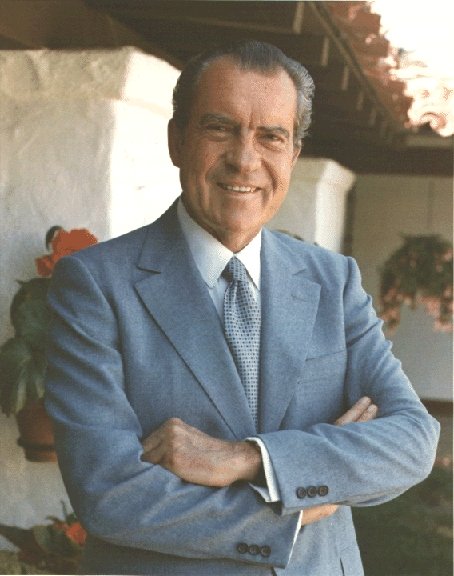
I decided to take a course about Richard Nixon this quarter taught by a former Nixon speech writer because I was eager to get a firsthand impression of the man and because ever since we watched All the Presidents Men in my high school journalism class, the Watergate burglary and subsequent coverup has fascinated me. Furthermore, Nixon as a person has remained something of an enigma to me. My impression before this course was that he did several bad things, but he had my sympathy because he was a man who achieved success not by winning popularity or looks contests but by working hard all his life.

As I began the course, I developed an even more sympathetic view towards Nixon. Some of the negative impressions I had of him were based on what I knew as his schmaltzy "Checkers speech" and his persistent investigation of former high-level State Department aide Alger Hiss. However, I began to understand through our readings in this course that Nixon's attempt to avail himself of accusations of campaign finance chicanery seemed justified since in fact, there appeared to be no evidence that he had done anything illegal. As for the Alger Hiss affair, it was eventually revealed that Hiss was acting as a spy against the government he worked for, so Nixon's hunch to investigate him seemed vindicated.

However, as we proceeded to study Nixon's career, my respect for him began to dwindle. I realized that even my own sense that he had such a difficult life was borne of Nixon's expressions of self-proclaimed hardships. Yes, Richard Nixon took some hard knocks in life, but, he seemed to use that as an excuse for his later indiscretions. For an idea of how another president publicly presented his difficult upbringing, one can look to Bill Clinton who grew up even poorer than Nixon but emphasized the hope that his life course signified. Unlike Nixon, who waxed kind of oddly at his final White House address that "my mother was a saint," Clinton seemed to have a more grounded and less self-validating view of his upbringing.

Furthermore, the fact that Richard Nixon never made a genuine expression of regret for his actions in the coverup of Watergate rankles me. His sense of those events, where he ordered the CIA to try to end the FBI investigation of the burglary and continued a massive effort at coverup therein, was that he never did anything that his "enemies" had not done, but as I wrote earlier and as others have pointed out, Nixon's corrupt acts far outnumbered his predecessors. There is evidence that he interfered in the 1968 Paris peace talks to end the war in Vietnam, that if true, means that he committed treason. He illegally bombed the country of Cambodia during that war, and even if he was not directly involved in the execution or ordering of the Watergate burglary, he ordered many other unethical and/or illegal actions be committed against Democrats.

Doing research for a final project on Nixon's relations with his successors has only hardened any sense I had that this man deserved our country's goodwill despite his transgressions. The conventional wisdom is that that "he mellowed and grew more philosophical" through his later years, but as this article suggests, he actually became more bitter in his obsession with getting Democrats. He and Clinton established a friendly relationship when Clinton came into office, and Clinton was the first president since Carter to invite Nixon to a public event at the White House. Until Nixon's death, they had relatively frequent phone calls with a good amount of personal exchange. However, Nixon thought that the Republicans should use suggestions that Clinton had been involved in an illegal real estate deal (of which he was later exonerated) to make him "pay the price" for what he felt was unfair targeting of himself over the years. Republicans must not "let [Whitewater] go down, must not let it sink," he said. Nixon called then-Senator Bob Dole to make sure aggressive questioners were placed on a Senate subcommittee looking into Whitewater. He also used his own personal understanding of Clinton to give Dole advice on the President's vulnerabilities (Nixon assumed Dole would be the 1996 nominee). Clinton for his part gave Nixon a gracious and some have suggested too generous eulogy at Nixon's funeral in April of 1994 where he said "May the day of judging President Nixon on anything less than his entire life and career come to a close."

Nixon's behavior towards Clinton, as I have come to learn, is characteristic Nixon and elicits a characteristic reaction about Nixon. When first reading about their relationship, my feelings warmed towards Nixon, as they had earlier in the course when reading about the misunderstandings around the Fund case and the Hiss case. I was taken in, as many have been, by the "New Nixon" posture. However, Nixon squandered any honorable gesture--as he always had--by allowing himself as usual to get caught up in his petty political vendettas and vortex of self-pity. Although I'm sympathetic to the fact that Nixon probably suffered from a psychological disease that made him depressed and angry, I think the revisionism on his character gives this small-minded man a lot more credit than is due.

Tuesday, February 21, 2006

Anti-Semitism in various guises

The past few weeks have been disappointing for those of us at Northwestern University who had hoped that Arthur Butz's most recent opportunistic attempt to get his Holocaust denial publicized would be largely ignored. To be honest, when I wrote this about three weeks ago, I was not anticipating that Butz would have such staying power in the campus news.

Why has Butz had such power? First, Northwestern's main newspaper, The Daily Northwestern made the absurd decision to solicit and publish an article by Butz. The Daily and a few students who wrote letters to the editor have been operating under the hopeless naivite that a man like Butz is equally as honest as actual Holocaust historians and that revisionistsof his stripe are unfairly persecuted for unpalatable views. On the contrary, as historian Deborah E. Lipstadt of Emerson University accounts in a column from yesterday's Daily, it has been Holocaust revisionists who have tried to persecute others for their views:
I say this with over six years of legal experience defending myself against David Irving, once the world’s leading Holocaust denier. He sued me for libel for calling him a Holocaust denier in one of my books. He waited until the book appeared in the United Kingdom where the burden of proof is on the defendant.

The Daily's decision to publish Butz seemed premised on the belief that Butz's methods for supporting his views are within the paramaters of intellectual honesty. As Professor Lipstadt explained so well, revisionists like Butz do not operate within such parameters. Witness her legal struggle with revisionist David Irving:

Rather than face any legal obstacles, Irving freely repeated his — and by extension Butz’s — arguments in court. The world press reported on them daily. No one faced any legal obstacles. No one was hauled into court except me.

I was able to mount an aggressive defense thanks to a defense fund which raised $1.75 million dollars. We hired a “Dream Team” of historians to closely examine Irving’s claims about the Holocaust. They found his work to be a “tissue of lies.”

By the end of my ten-week trial Irving was left looking like the Court Jester. He had called the judge “Mein Fuhrer,” a telling slip. When asked by Richard Rampton, my barrister, how he could say Herman Goring “goggled” at a certain exchange, when there was absolutely no evidence that Goring was even at this meeting, Irving declared: “author’s license.”


Butz is guilty of this same dishonesty:

Butz, in his column, engages in linguistic tricks. He claims that Timothy Ryback wrote in the Wall Street Journal that “there is little forensic evidence proving homicidal intent” in the ruins of Auschwitz. Butz ignores another portion of Ryback’s comment regarding Auschwitz: “these heaps of dynamited concrete and twisted steel are not only historic artifacts but among the few remnants of untainted, forensic evidence of the Holocaust.”

Why do we not enter further into “debate” with him? Because debating people who deliberately mislead is like trying to nail a blob of jelly to the wall. There is no end to the matter. If they have no fidelity to the truth how can you debate them? They just make things up as it suits them.


Professor Lipstadt's words should be heeded. Unfortunately, in today's Daily, a student columnist has picked up where Butz left off--constructing an uninformed argument that reveals this student's latent belief in age-old anti-Semitic conspiracies of Jewish cabalism and. There's no need to explicate the article itself: the main point is the deeply troubling sanctioning of anti-Semitic views by a student newspaper with a misguided understanding of free expression.

Sunday, February 05, 2006

Holocaust denier supporting Iran

Professor Arthur Butz, who remains on tenure here at Northwestern in engineering is back in the news:
Engineering professor Arthur Butz said Friday that he agrees with Iranian President Mahmoud Ahmadinejad's remarks calling the Holocaust a "myth." Butz said his comments supporting the president recently were published by the English-language Tehran Times and Iran's semi-official Mehr news agency.

Here's my proposition for Mr. Butz: go to Iran. Try being a professor in the environs of that repressive state. If you support a head of state who is blatantly anti-Semitic and bent on destroying Israel, go live in his country. I don't know whether this guy should be fired, because I guess he's never espoused his views in class, but he should voluntarily move to Iran.

Friday, February 03, 2006

Republican party not a party for moderates

Last night, former governor of New Jersey and secretary of the Environmental Protection Agency Christine Todd Whitman was the guest on the Colbert Report. Most of the interview focused on her new efforts at trying to strengthen and assert the moderate voices in the Republican party, and she has launched a PAC and website for this purpose. While Whitman's effort is admirable enough, I think she is ignoring the political tides of today. The Republican party has gotten so far from being the party of Lincoln, or even Eisenhower, or even 1964 extremist Barry Goldwater. (Goldwater has now become a moderate relative to today's Republican party. Among other things, he has said this about the church and state issue: It's wonderful that we have so many religious people in our party, ... They need to leave their theologies in their churches.” and this defending the rights of gays: The rights that we have under the Constitution covers anything we want to do, as long as its not harmful. I can't see any way in the world that being a gay can cause damage to somebody else,”).

Throughout the 1960s and into the 1970s, the Democratic party saw its composition changed. Once Lyndon Johnson put the national party firmly in favor of civil rights for African Americans, he lost a lot of people in the South who had once voted as Democratic populists but who opposed rights for blacks. The Republican party--once a party of many leaders who stood behind civil rights--in turn picked up disaffected Democrats.

I think Whitman will have to understand that she cannot make this current Republican party moderate. The current GOP is not against big government as Barry Goldwater was, and they are certainly in favor of infringements on privacy--from reproductive rights to religious rights to being anti-civil liberties. They are not even a shadow of their former selves. I personally would probably have never voted for even a moderate Republican in the 1950s and 1960s unless the Democrat opposing that person was a racist (mainly because I think I would have liked the Democrats better), but the Republican party has few of those left. The ones who bill themselves as moderate, like Arlen Specter of Pennsylvania and Olympia Snowe and Susan Collins of Maine, are either marginalized or vote with the extremists (e.g. the Alito vote).

So my message to Christine Todd Whitman: change parties--though you may not be in agreement with the Democratic party on all issues (I'm certainly not in agreement with them on all issues!), you will at least be heard, especially since the party is so keen on centrists anyway.

Tuesday, January 31, 2006

Waiting for historical perspective

It's funny the way creating history works. Once it is established, it can be accepted as conventional wisdom--so much so that people will act as if they knew things all along that in fact they didn't. Charles de Gaulle advanced the myth that all of France but the Vichy Regime had resisted the Nazi Occupation. For awhile, this became the conventional wisdom.

Most people today still think of Nixon as a bad president, mainly because he greatly abused executive power. Back when Bob Woodward and Carl Bernstein were exposing the connections between the Watergate burglary and the White House, however, many people defended Nixon.

It is frustrating that the French couldn't be resistors at the time, or that Americans once liked Nixon enough to give him an overwhelming electoral victory in 1972. Yet it happens. How does it happen? It happens for the same reason that Bush is still president today: because people cannot see the big picture and the media will not report it. Bush and his administration have consistenly abused their power. They have brought the country into an irresponsible war based on a farce. They have greatly increased the deficit. They have worked to increase the profits of already wealthy people. Most of these things would justify impeachment, all of them would justify being resoundingly voted out of office.

Their abuses of power have been worse than Nixon's, their corporate welfare has been worse than Warren G. Harding's, their war has not yet been as deathly as Vietnam, but it too is based on misrepresentation of the facts. Ulysses Grant let political cronies get too much influence when he was president, but at least he was well-intentioned. George W. Bush does the same thing without being well-intentioned.

Richard Reeves said at the end of last year:
I have talked with three significant historians in the past few months who would not say it in public, but who are saying privately that Bush will be remembered as the worst of the presidents. There are some numbers. The History News Network at George Mason University has just polled historians informally on the Bush record. Four hundred and fifteen, about a third of those contacted, answered -- maybe they were all crazed liberals -- making the project as unofficial as it was interesting. These were the results: 338 said they believed Bush was failing, while 77 said he was succeeding. Fifty said they thought he was the worst president ever. Worse than Buchanan. This is what those historians said -- and it should be noted that some of the criticism about deficit spending and misuse of the military came from self-identified conservatives -- about the Bush record.

It does not matter now what the historical evaluation of Bush will be, of course. We should worry more about what he is doing in the present. Still, if somehow all of the pundits who kiss his butt and all of the journalists who avoid investigating his administation and all of the politicians who are too afraid to stand up to him could take a time machine to the future and see that Bush may be seen as Harding times Buchanan squared--maybe they would do something now.

Wednesday, January 18, 2006

A little enlightenment on the media

One great thing about being in a class where the professor was once part of a presidential administration is that every so often, an interesting person who he knows makes an appearance in class. Today, author Richard Reeves, who has written books on American presidents John F. Kennedy, Richard Nixon, and his most recent President Reagan: The Triumph of Imagination came to my Rhetoric of the American Presidency class to talk. I've actually read his books President Kennedy: Profile of Power and President Nixon: Alone in the White House which are great for all of the primary documents which Reeves has access too, including tapes, diaries, etc.

After he spoke, we got to ask him some questions, and I asked him what he thought about the media coverage of presidents and whether it was fair to say Kennedy and Reagan received good coverage and Nixon and Clinton bad coverage. His answer was very interesting. He said that for one, back when the media was covering Kennedy and Nixon in the late 1950s and early 1960s, most reporters were not part of a professional class of people who had received masters from the likes of Northwestern's Medill School or Syracuse. Back then in fact, they shared the economic views of other members of the working class--pretty different than today's media composition. Kennedy was appealing because of his good looks, good nature, new liberalism (though he wasn't as liberal as people think) and also his war hero status. When Reagan came along, the media--now a professional class--seemed to know less than they thought they did, portraying him as a genial but somewhat clueless old man who took a snooze next to Pope John Paul II, though Reagan was much savvier than that. So that's my slipshod summary of Reeves's comments about the media, but needless to say, his book on Reagan looks interesting.

Did people used to try to be intellecutals?

Today a thought that has often popped into my mind reentered. This thought will come off as shameless elitism written down, but I have to say it one way or another: how do so many apparently unimpressive people get into selective universities? Or at least my selective university? I'm not saying this because I think I'm brilliant but rather because I'm surprised people don't have more interesting interests. Like academics for instance. I'm not saying that life revolves around schoolwork, or that I expect everyone to be as much of a nerd as I am, but when you that someone's favorite book is The Notebook or chick lit--favorite book, mind you. I guess I do not understand the conformist tendencies of my generation to the point where I expect that people at good universities would rise above the banal

Monday, January 09, 2006

Idle Wealth

This quarter I'm taking a class about Richard Nixon, studying in particular the rhetoric of his presidency. Already, this course has imparted a complex impression of Nixon. One of the most interesting things about him, for me, is that he grew up without privilege and throughout his life he positioned himself against those who were born to wealthy families, with elite educations, smooth social skills, and good looks. Although my political views would have probably conformed to his opponent in the 1960 presidential election, John F. Kennedy, I would have found Nixon to have the more appealing personal life. It was Nixon, after all, who worked tirelessly to attain a good education and a distinguished career in the face of many setbacks.

Ironically, Nixon belonged to a party that today is effectively preventing the social mobility that Nixon enjoyed. Most recently, financial aid to college students has been cut by 14.3 billion dollars, which amounts to a $5,800 increase (from added interest payments and grant reductions) for the average college student on financial aid.

That is but one example of the way in which our country's once-great promise of social mobility is being torn apart. Among some groups in our society, there is a sense that the richest person is the most entitled to succeed. Often though, the sons and daughters who have been acquainted all of their lives with wealth and luxury are the ones with the worst performance at school, the so-called playboys who find their purpose in life is to drink and be merry as if trying their damndest to prove the accuracy of an F. Scott Fitzgerald novel. Our current president is a perfect example of one who was raised to expect wealth and distinction without working towards it.

The expression that suggests that everything is politics is anethema to some, but it is true. In this case, the luxurious decadence of the heir(ess) that is glorified by the media is becoming solidified and multiplied via public policy and our economy's pay structure. During the mid 1900s, America enjoyed the largest middle class in maybe any nation's history, with a resurgence in the 1990s. Now, due to a certain dysfunction of values and bad public policy, our country is increasingly ensuring that the rich, popular, idiot that you knew in high school--a person of idle wealth--will succeed over the person who has worked hard.