Once in a vision
I came on some woods
And stood at a fork in the road
My choices were clear
Yet I froze with the fear
Of not knowing which way to go
One road was simple
Acceptance of life
The other road offered sweet peace
When I made my decision
My vision became my release.-Dan Fogelberg
Why am I quoting a singer whose best-known hit has probably been played in every elevator and dentist's waiting room in the nation? Well, in fairness to Mr. Fogelberg, I like this quote and when I was younger, pondered it when his tapes were playing in the family car. I remember, for instance, never really knowing which road he meant for us to think that he chose.
I ponder this line again because I am at something of a fork in the road in my own life. I have an exciting--though somewhat open-ended--opportunity to live in France for about eight months of the 2006-2007 year. On the other hand, I can get a job in D.C. in areas that I have long thought myself to be interested in (policy, political advocacy, or public interest). Back when I was merely applying for the job in France, I had it in the back of my mind that I was doing so simply to keep all my options open. The fact that the position didn't seem to promise the beginning of a career (teaching job) and didn't pay very well (though the work hours are hardly demanding) made me nervous. At the same time, gaining a stronger command of the French language and returning to a country I love excited me.
Now, as I think more seriously on the choice, and get admittedly excited about the opportunity to go to France--and simultaneously nervous that I am idealizing this opportunity--I think back to the fork in the road metaphor. For me, this "fork" brings out a conflict of impulses that I have had for awhile now: on the one hand, I get frustrated over the way in which my generation is expected to have everything planned out. From day one at my high school, many students were participating in activities and striving to get grades that wiput them in an ideal college so to get to an ideal graduate school, so to get an ideal job. There's no room in this mentality for what is called (melodramatically, maybe) soul-searching. I long for the era that my parents' generation came of age in, one that I have mythologized as more laid-back than our's. If I go to Europe, I'll be living at least some semblance of what I imagine this era to be.
The other impulse reminds me of how much of an investment college is, how much I want to work to change certain things about the United States (rather than just become a temporary expat), and reminds me that many of my peers are getting their careers started in law school or with impressive jobs. I wonder if only decadent people can afford to take off to France after four years of college.
Maybe I am just as bad as the societies that idealized the "noble savage," when I say that I want to return to a simpler life. Still, I think that there is something to be said for the perhaps trite idea that money and power are not everything and in fact, can make for a complicated, stressful existence. Yes, some level of comfort is ideal, which is why I am for such things as universal health care, but the way the United States values the act of striking it rich (or more recently, being born rich), does not account for the way this devalues other important aspects of life. Such aspects include having a good balance between work and leisure, eating well, getting outdoors (rather than just to the gym), and keeping oneself entertained without the latest entertainment technology gadget. France, to some extent, still allows for this lifestyle. (Granted, they have their own problems there).
Anyway, those are my current thoughts on this difficult but definitely exciting decision.
Wednesday, May 10, 2006


Friday, May 05, 2006
Stephen Colbert: making news in spite of the MSM
By suggestion, I am writing about Stephen Colbert's bit at the White House correspondents dinner. The way everything has played out--Colbert's great routine, the chilly reception on the part of the dinner attendees, the lack of print accorded to what was certainly the most newsworthy moment at a usually unexciting event, and the subsequent outcry by bloggers and many in the alternate media--point to the mainstream media (or MSM)'s decreasing relevancy.
Of course, they still have the largest megaphone, so to speak, which is free use of our nation's airwaves and mass-circulating, well-recognized newspapers, but as this group continuously clams up when faced with giving attention to events like the Colbert routine (not to mention a lot of troubling societal problems like stagnant wages, decreased social mobility, etc.), others are stepping in. The MSM is unsurprisingly treating them as crazy, unrelenting, out of the mainstream, and so on. They've been trying to write off bloggers forever, but in so doing, they're writing off the actions of average citizens. I don't know what's more elitist than that.
Take for instance how PBS's News Hour reported an instance in January when the ombudsman of the Washington Post shut down the comments page on the paper's website after posters wrote her that she had misrepresented the nature of former lobbyist Jack Abramoff's donations:
Note the words used to describe the commenters and their actions. They're not treated as concerned citizens who would like to see a large newspaper rectify its mis-reporting but rather are treated as a "deluge."
So back to Colbert. Again, the MSM reveals how uninterested--or perhaps just scared--they are to report strong criticisms of the Bush Administration, even if these criticisms are cloaked in humor. Again, the MSM demonstrates their irrelevancy. As a Time magazine television critic said recently, "What anyone fails to get who said Colbert bombed because he didn't win over the room is: the room no longer matters. Not the way it used to." Furthermore, "Colbert's roasting of the president this weekend got nearly 70,000 posts on blogs according to the blog-tracking Web site Technorati -- the most of any subject Thursday" according to an NBC correspondent. As a result, the MSM has had to acknowledge that this is a story.
Now, the talking point among the MSM has become that Colbert's skit was "not funny," which is not only blatantly wrong, but it also doesn't make the event any less newsworthy. (If the news got reported on based on their funiness, the D.C. press corps would be out of jobs). As Consortiumnews.com points out about the "not funny" line:
Of course, they still have the largest megaphone, so to speak, which is free use of our nation's airwaves and mass-circulating, well-recognized newspapers, but as this group continuously clams up when faced with giving attention to events like the Colbert routine (not to mention a lot of troubling societal problems like stagnant wages, decreased social mobility, etc.), others are stepping in. The MSM is unsurprisingly treating them as crazy, unrelenting, out of the mainstream, and so on. They've been trying to write off bloggers forever, but in so doing, they're writing off the actions of average citizens. I don't know what's more elitist than that.
Take for instance how PBS's News Hour reported an instance in January when the ombudsman of the Washington Post shut down the comments page on the paper's website after posters wrote her that she had misrepresented the nature of former lobbyist Jack Abramoff's donations:
The Jack Abramoff scandal is one of the most explosive stories in politics these days but when Washington Post ombudsman Deborah Howell recently wrote about the paper's coverage of this story, little did she know that she was setting off a firestorm of her own.
...She was then deluged with close to 1,000 comments, most critical of her suggestion that both parties were complicit in the scandal.
...But the online onslaught didn't stop. [Emphasis added].
Note the words used to describe the commenters and their actions. They're not treated as concerned citizens who would like to see a large newspaper rectify its mis-reporting but rather are treated as a "deluge."
So back to Colbert. Again, the MSM reveals how uninterested--or perhaps just scared--they are to report strong criticisms of the Bush Administration, even if these criticisms are cloaked in humor. Again, the MSM demonstrates their irrelevancy. As a Time magazine television critic said recently, "What anyone fails to get who said Colbert bombed because he didn't win over the room is: the room no longer matters. Not the way it used to." Furthermore, "Colbert's roasting of the president this weekend got nearly 70,000 posts on blogs according to the blog-tracking Web site Technorati -- the most of any subject Thursday" according to an NBC correspondent. As a result, the MSM has had to acknowledge that this is a story.
Now, the talking point among the MSM has become that Colbert's skit was "not funny," which is not only blatantly wrong, but it also doesn't make the event any less newsworthy. (If the news got reported on based on their funiness, the D.C. press corps would be out of jobs). As Consortiumnews.com points out about the "not funny" line:
Consortium continues:Milbank’s assessment was shared by many journalists at the dinner, a reaction that can partly be explained by the pressure Washington reporters have long felt from well-organized right-wing media-attack groups to give Bush and other conservatives the benefit of every doubt. [See Consortiumnews.com's "The Bush Rule of Journalism" or Robert Parry's Secrecy & Privilege.]
Even before the Colbert controversy, the White House Correspondents’ Association annual dinner and similar press-politician hobnobbing have been cringing examples of unethical journalistic behavior.
The American people count on the news media to act as their eyes and ears, as watchdogs on the government, not lap dogs wagging tails and licking the faces of administration officials. Whatever value these dinners might once have had – as an opportunity for reporters to get to know government sources in a more casual atmosphere – has long passed.
Since the mid-1980s, the dinners have become competitions among the news organizations to attract the biggest Hollywood celebrities or infamous characters from the latest national scandal. Combined with lavish parties sponsored by free-spending outlets like Vanity Fair or Bloomberg News, the dinners have become all about the buzz.
Plus, while these self-indulgent affairs might seem fairly harmless in normal political times, they are more objectionable when American troops are dying overseas and the Executive Branch is asserting its right to trample constitutional rights, including First Amendment protections for journalists.
Remember Bush's supposedly comic routine from a couple of years ago where he was searching under his desk for WMDs? The sight of an insulated White House press corps sitting in that banquet room watching and laughing a skit that basically trivialized our military's presence in Iraq was pretty sickening. Colbert is just tugging the veil off of a discomfiting relationship between the MSM and the current president, and it's not surprising that they're both mad at him for it.
Tuesday, May 02, 2006
Daily musings
Today I had some free time and walked out to the lake on the far eastern end of our campus. I'm not the first nor will I be the last to muse about our peaceful natural setting and its ability to transport one to a different plane than is the norm. Life seems fleeting staring out at a vast expanse that appears unending, and it can be liberating to realize this.
Now I am sitting in the library where students are working on various assignments and checking e-mail. For some reason, my eyes are wandering over to the note on my Diet Code Red bottle that says "For Best Taste Drink by Date on Bottle." Maybe none of this is that big a deal or maybe I'm just hopped up on Code Red.
Now I am sitting in the library where students are working on various assignments and checking e-mail. For some reason, my eyes are wandering over to the note on my Diet Code Red bottle that says "For Best Taste Drink by Date on Bottle." Maybe none of this is that big a deal or maybe I'm just hopped up on Code Red.
Thursday, April 27, 2006
How the American Dream and wearing Prada are (not) connected
Before I started college, I had it in my head that the average student became accustomed to a modest living. I had visited my Dad's alma mater and seen his hole-in-the-wall apartment, and I had heard about the high tuition bills that would come with attending a reputable university. College did not seem a time to make luxury purchases. Imagine my surprise then, when I arrived on campus and saw students with pricy Longchamp bags, designer jeans, and sizable shoe collections. This, I thought, is college? Not that I deny my own love for clothes and shopping, but I had never imagined Prada to be part of the college student's wardrobe.
Yesterday a friend pointed me to an article that explicates what many of us have thought true for a long time: that the American Dream that one can succeed through hard work and ingenuity in this country, no matter how destitute he may be at the beginning of his life, is now mostly a myth. This article spotlights a study of 4,000 children whose parents' income had been monitored first in 1968 and whose own incomes were then examined approximately 30-years later. Furthermore, the likelihood of someone born into a poor family making it into the top 5 percent is much less here than in other countries. For those born into wealth, their chances of getting rich are considerably higher: they are 20 percent more likely to make it into the top 5 percent than their poor counterparts.
How better to cap off this finding than with an article featured in a special pullout section on college education in the New York Times? This article, called "What they're Wearing at..." features several Columbia University students. One woman is shown wearing "vintage boots and a Ferragamo bag found in Paris and a Valentino scarf bought on a deep discount in Lower Manhattan," a man is shown wearing a jacket "bought with an assist from a personal shopper." As he puts it: "My mother told me to go to Bloomingdale's and treat myself." Another fashionably dressed young man "exchanged a gift from his 'well-intentioned' sister for his Prada sunglasses." Columbia's style editor at the campus paper is quoted as saying that the university" is a "place where privilege and experience meet." She's at least right about the former.
Sunday, April 23, 2006
Manifesto of what I don't want to hear while I'm eating
Today my friend made the apt point that women can often be their own worst enemies. I wouold add a corollary to this: some women are everyone's enemy at the dinner table. This is something I have come to realize especially in college, and was illuminated to me again last night when someone told me it actually can be a chore to eat with certain girls because of how dull and annoying their conversation is while they are eating. Not all girls, mind you, but many, and thus, I present you a manifesto of what I don't want to hear while eating with you. Bascially, anything related to dieting, exercise, calories, is incredibly annoying!
This list could of course go on and on, but my fundamental issue is that I want to eat in peace. Women are socilialized in our society to think it is bad to eat, and that is truly unhealthy. Women of America, unite against this conventional wisdom, and let yourself eat to enjoy food rather than to fear it. Or at least don't drag me into your sprial of food obsession!
- "I've eaten so much today."
- "I didn't go to the gym today. With what I'm eating now, I better go tomorrow."
- Any general account of one's gym schedule (I don't care!)
- How the no fat salad dressing really isn't that bad (pshaw)
- "I just can't eat [fill in the blank]" referring to something that I am eating (usually something "adventerous" or not particularly healthy). Guess what, no one's making you eat it, so let me eat it in peace!
- An oral food diary (again, I don't care what you ate today!)
- "I need to lose weight"
- "[Fill in the blank] is so skinny." or "[Fill in the blank] has so much self-control."
This list could of course go on and on, but my fundamental issue is that I want to eat in peace. Women are socilialized in our society to think it is bad to eat, and that is truly unhealthy. Women of America, unite against this conventional wisdom, and let yourself eat to enjoy food rather than to fear it. Or at least don't drag me into your sprial of food obsession!
Tuesday, April 18, 2006
Daily article
Check out my article in the Daily Northwestern. It is basically a rendition of this post from earlier, so I won't post it again, but feel free to give it a read!
Go U
Just overheard the quintessential Northwestern student conversation on the shuttle, complete with
-reference to high school smarts: "took 3 AP science classes," "multivariable calculus," "only got 4s on two of the APs"
-boast of not studying: "in senior year i just jacked off and copied off of other people"
-put down of person smarter than self: "she took like linear algebra sophomore year...but was socially retarded"
-anticipation of arrival at the Keg: "dude we got on the wrong shuttle" "no, this one goes to the keg"
...see why NU students annoy me sometimes?
Sunday, April 16, 2006
I've had it with these snakes!
Some of you may have heard of the movie Snakes on a Plane starring Samuel L. Jackson, set to be released in August of this year. I would detail the plot, but is it really that important? All I care about is the fact that there are snakes on a plane and Samuel L. Jackson is going to show them who's boss. For a long time, Snakes on a Plane was the reject of New Line Cinema, constantly two snips away from the cutting room floor.

I've had it with these snakes!
Samuel L. Jackson's attitude towards the movie has been just delightful and can be summed up with these choice quotes:
-on the unthinkable near-change of the film's official title
If you want more info, check out snakesonablog.com.
It was shot with little fanfare, and I think I can safely say that five years ago or so, Snakes on a Plane would have lived out this dreadful fate. In 2006, however, with the wonders of the world wide web and all of its communication powers, Snakes on a Plane has become an internet legend, eagerly anticipated by all who understand the sheer beauty of what it represents as a film that carries out perfectly the equation for formulaic Hollywood movie: cramped space+terrorist threat+swearing mofo actor+funny fat guy who is really scared (played by Keenan Thompson)=summer movie, but with the ridiculous twist of the insidious enemy being snakes. Yes, snakes!

I've had it with these snakes!
Samuel L. Jackson's attitude towards the movie has been just delightful and can be summed up with these choice quotes:
That's the only reason I took the job: I read the title.
-on the unthinkable near-change of the film's official title
So people who have a fear of flying and people who have a fear of snakes are going to have a double whammy.
It's kind of going to be great.
If you want more info, check out snakesonablog.com.
Friday, April 14, 2006
| the Provacateur |
| VULGAR | COMPLEX | DARK You'll crack on anything, and you're often witty, even caustic, about it. Therefore, your sense of humor is polarizing. You're transgressive, and you've got a seriously sharp 'edge'--maybe too much for some folks. If they get you, people think you're one of the funniest (and smartest) people in the world. If they don't, they think you're an ass. Whatever, right? While some might question your judgement, your comic intellect is unquestionably respected. PEOPLE LIKE YOU: Chris Rock - Lenny Bruce - George Carlin  The 3-Variable Funny Test! - it rules - If you're interested, try my latest: The Terrorism Test |
My test tracked 3 variables How you compared to other people your age and gender:
|

| Link: The 3 Variable Funny Test written by jason_bateman on Ok Cupid, home of the 32-Type Dating Test |
Thursday, April 13, 2006
The Politics of a Commencement Speaker
Today most Northwestern students that I know in the Class of 2006 (by no means a representative sampling) were pleasantly suprised to learn that U.S. Senator Barack Obama will be our commencement speaker. People from the class of 2005 with whom I spoke were also jealous. John McCain, the speaker from last year, I learned, had done a bad job. He was "too political." People hoped that Obama wouldn't be as political. "I hope he'll say something inspirational," was one sentiment. What, though, does it mean to be inspirational? I hope it doesn't mean to be contrived or maudlin or too praiseworthy, and I hope that students from a university as good as this one want more than just cheap inspiration, want more than an oral version of those trite posters with captions that say "Teamwork" or "Challenge." If that's all we can stomach, then maybe Obama isn't our guy. After all, he told this to the Class of 2005 at Knox College in Galesburg, Illinois as their commencement speaker last year:
I'm presuming that when people say they don't want to hear about the political in a commencement address, they in part are speaking of not wanting to hear about the outside world and all of its problems. We students have been insulated enough from that world for the past four years that it shouldn't hurt us to be challenged for 30 minutes.
And yes, Obama was political in his Knox College address, at least insofar as he expressed a point-of-view that may be disagreable to some:
John McCain was also political in his commencement address at Northwestern last year. What made McCain's commencement address less palatable than Obama's was not so much that it was "political" but that it did not represent a call to the new graduates to act, as Obama's did. Instead, it represented a defense of the Bush Administration foreign policy. Yes, McCain did tell students that "the world is about to become your responsibility," but he did not mount a challenge to them as Obama did. He spoke of the immorality of genocide, but who disagrees with that? What I want to know is what I can do about it, and not just from McCain's call to "support action," especially if all military action is lumped under spreading freedom of which the administration which McCain so strong supports is guilty. Obama went much further, putting this challenge to the Knox students:
Instead of doing nothing or simply defending 20th century solutions, let’s imagine together what we could do to give every American a fighting chance in the 21st century.What if we prepared every child in America with the education and skills they need to compete in the new economy? If we made sure that college was affordable for everyone who wanted to go? If we walked up to those Maytag workers and we said “Your old job is not coming back, but a new job will be there because we’re going to seriously retrain you and there’s life-long education that’s waiting for you—the sorts of opportunities that Knox has created with the Strong Futures scholarship program.
What if no matter where you worked or how many times you switched jobs, you had health care and a pension that stayed with you always, so you all had the flexibility to move to a better job or start a new business? What if instead of cutting budgets for research and development and science, we fueled the genius and the innovation that will lead to the new jobs and new industries of the future?
I'm presuming that when people say they don't want to hear about the political in a commencement address, they in part are speaking of not wanting to hear about the outside world and all of its problems. We students have been insulated enough from that world for the past four years that it shouldn't hurt us to be challenged for 30 minutes.
And yes, Obama was political in his Knox College address, at least insofar as he expressed a point-of-view that may be disagreable to some:
Like so much of the American story, once again, we face a choice. Once again, there are those who believe that there isn’t much we can do about this as a nation. That the best idea is to give everyone one big refund on their government—divvy it up by individual portions, in the form of tax breaks, hand it out, and encourage everyone to use their share to go buy their own health care, their own retirement plan, their own child care, their own education, and so on.
In Washington, they call this the Ownership Society. But in our past there has been another term for it—Social Darwinism—every man or woman for him or herself.
John McCain was also political in his commencement address at Northwestern last year. What made McCain's commencement address less palatable than Obama's was not so much that it was "political" but that it did not represent a call to the new graduates to act, as Obama's did. Instead, it represented a defense of the Bush Administration foreign policy. Yes, McCain did tell students that "the world is about to become your responsibility," but he did not mount a challenge to them as Obama did. He spoke of the immorality of genocide, but who disagrees with that? What I want to know is what I can do about it, and not just from McCain's call to "support action," especially if all military action is lumped under spreading freedom of which the administration which McCain so strong supports is guilty. Obama went much further, putting this challenge to the Knox students:
Now, no one can force you to meet these challenges. If you want, it will be pretty easy for you to leave here today and not give another thought to towns like Galesburg and the challenges they face. There is no community service requirement in the real world; no one is forcing you to care. You can take your diploma, walk off this stage, and go chasing after the big house, and the nice suits, and all the other things that our money culture says that you should want, that you should aspire to, that you can buy.
But I hope you don’t walk away from the challenge. Focusing your life solely on making a buck shows a certain poverty of ambition. It asks too little of yourself. You need to take up the challenges that we face as a nation and make them your own. Not because you have a debt to those who helped you get here, although you do have that debt. Not because you have an obligation to those who are less fortunate than you, although I do think you do have that obligation. It’s primarily because you have an obligation to yourself. Because individual salvation has always depended on collective salvation. Because it’s only when you hitch your wagon to something larger than yourself that you realize your true potential.
Yes, I don't want to hear a McCain-style foreign policy explication on graduation day, but I also don't want to hear an effusively trite speech. That's why I'm glad Obama is our speaker.
Wednesday, April 12, 2006
'The Way of the Tuna'
I was dismayed to learn today from a Chicago Tribune article that the American seafood industry is owned in large part by Reverend Sun Myung Moon, the head of the Unification Church, who claims that he is the Messiah, who conducts mass weddings in Madison Square Garden, and who owns the right-wing Washington Times. According to the Tribune he also owns a lot of raw fish:
 Some of this is admittedly quite funny, however, like Moon's manifesto to take over the world--one sushi restaurant at a time:
And yes, some of the profits from Moon's seafood business, True World Foods, does make its way to the Unification Church. Even though True Foods is known for reliably delivering high quality sushi, they have received some food santiation citations:
Reverend Moon says that Jesus asked him back in the 1950s to save humanity. I wonder if Jesus also asked Rev. Moon to supply sushi restaurants, because he would do better to re-focus his attentions on saving humanity.
Adhering to a plan Moon spelled out more than three decades ago in a series of sermons, members of his movement managed to integrate virtually every facet of the highly competitive seafood industry. The Moon followers' seafood operation is driven by a commercial powerhouse, known as True World Group. It builds fleets of boats, runs dozens of distribution centers and, each day, supplies most of the nation's estimated 9,000 sushi restaurants.
 Some of this is admittedly quite funny, however, like Moon's manifesto to take over the world--one sushi restaurant at a time:
"I have the entire system worked out, starting with boat building," Moon said in "The Way of Tuna," a speech given in 1980. "After we build the boats, we catch the fish and process them for the market, and then have a distribution network. This is not just on the drawing board; I have already done it."Between detailing gay sex practices and outlining sushi takeovers, sermons have really changed since the days when people would just talk about, say, Bible verses.
In the same speech, he called himself "king of the ocean."
And yes, some of the profits from Moon's seafood business, True World Foods, does make its way to the Unification Church. Even though True Foods is known for reliably delivering high quality sushi, they have received some food santiation citations:
Last year, after repeated FDA inspections found "gross unsanitary conditions" at True World's suburban Detroit plant, the facility manager tried to bar inspectors from production areas and refused to provide records, according to an FDA report. The plant manager told the inspectors that his True World supervisor was "a great man, that he was a part of a new religion, and that if we took advantage of him, then `God help you!'."
Later, according to that FDA report, an employee wearing a ski mask approached one female inspector, put his thumb and forefinger in the shape of a gun, pointed at her and said: "You're out of uniform. Pow!"
Reverend Moon says that Jesus asked him back in the 1950s to
 save humanity. I wonder if Jesus also asked Rev. Moon to supply sushi restaurants, because he would do better to re-focus his attentions on saving humanity.
Thesis Abstract
I just thought I would post my thesis abstract up here because, well I made one, and it's due in three weeks I think, and I don't feel like writing something new. So here it is in all of its glory (not really):
Une Nouvelle Littérature Américaine:
French Readings of American Literature in the Interwar Years
Between the early 1920s and the mid-1930s, articles appeared in French journals heralding the arrival of a new American literature. Written by prominent French intellectuals, these commentaries almost uniformly concluded that certain works of the American realist school of literature by authors including Willa Cather, Theodore Dreiser, John Dos Passos, and Sinclair Lewis, provided a window into the soul of American life. They simultaneously insisted that American culture was on a decline because of its captivity to mass preferences. As a result, these French intellectuals concluded that many of the best American authors expatriated to
Saturday, April 08, 2006
An historical moment: the rise of political blogs
I am thoroughly enjoying Bill McKibben's review of Crashing the Gate: Netroots, Grassroots, and the Rise of People-Powered Politics by bloggers Jerome Armstrong (of My DD) and Markos Moulitsas Zúniga (of the Daily Kos). McKibben's review provides an historic overview of the internet's affect on politics in the United States, which must by any measures be understood as monumental. Take as an example the Democratic Senatorial primary challenge in Connecticut that is being waged by Ned Lamont. Not only have blogs like The Daily Kos consistently drummed up support and financial contributions for Lamont (I myself made a small donation to the campaign), but these blogs also began the drumbeat for change in Connecticut in view of current-Senator Joseph Lieberman's unbelievable unwillingness to challenge George W. Bush or to change his position on supporting Bush's Iraq War.
According to McKibben, such blogger-driven influence emerged when the Presidential campaign of Vermont governor Howard Dean coincided with and picked up on the voices of regular Americans in 2003, a movement that, as McKibben says, "rose in the shadows of the Bush ascendancy in the years following September 11, when very few people—certainly not presidential candidates with an eye to getting elected—were willing to challenge the White House directly." These voices were coming especially from the web, where Americans were logging on to connect with their fellow citizens who shared similar sentiments but were scattered across the country. The internet bridged this geographic divide and therefore created a new, people-powered movement. As McKibben says:
Such influence was acknowledged in an April 2 article in the New York Times about the internet's influence on politics and campaigning. Most encouraging, perhaps is the threat that web use brings to the television campaign ad, what has morphed into one of the most deplorable and methods of vote-getting because of how wellthe television medium facilitates half-truths and fear-mongering:
Of course, the internet has brought with it certain ills too, from shadowy kiddie porn rings to well shadowy bestiality rings, but the success of blogs like those of Jerome Armstrong's and Markos Moulitsas's is encouraging when one thinks back to the helpless and depressed state many of us were in six years ago after a bunch of cronies essentially decided the president of the United States instead of looking to the votes of the American people.
According to McKibben, such blogger-driven influence emerged when the Presidential campaign of Vermont governor Howard Dean coincided with and picked up on the voices of regular Americans in 2003, a movement that, as McKibben says, "rose in the shadows of the Bush ascendancy in the years following September 11, when very few people—certainly not presidential candidates with an eye to getting elected—were willing to challenge the White House directly." These voices were coming especially from the web, where Americans were logging on to connect with their fellow citizens who shared similar sentiments but were scattered across the country. The internet bridged this geographic divide and therefore created a new, people-powered movement. As McKibben says:
the Dean campaign also launched the Internet era in American politics. Previously, even if people became excited about a candidate in the primaries, there wasn't all that much they could do to help. They might find a mailing address and send a check, or wait for the primary campaign to reach their state so they could take part in the campaign and then vote. But Dean's young campaign staff opened a new channel through their Web site Deanforamerica.com, which featured the then still fresh idea of a blog.
...Most important of all, they pioneered on-line money-raising. Every time something unusual happened (when some pundit would disparage the "kiddie corps" running the Dean show, say) the Web site staffers would "put up a bat" on the home page—a picture of a baseball bat, empty like a United Way thermometer in front of a town hall, which they would fill with red as the contributions would come in from people taking a few minutes to read the blog from their home or office computers. The supporters of the Dean campaign easily raised more money than their opponents in the early primaries and caucuses, and for the first time in recent political history, they did it largely with $20 and $50 and $75 contributions from across a large base of his ardent fans.
Such influence was acknowledged in an April 2 article in the New York Times about the internet's influence on politics and campaigning. Most encouraging, perhaps is the threat that web use brings to the television campaign ad, what has morphed into one of the most deplorable and methods of vote-getting because of how wellthe television medium facilitates half-truths and fear-mongering:
Analysts say the campaign television advertisement, already diminishing in influence with the proliferation of cable stations, faces new challenges as campaigns experiment with technology that allows direct messaging to more specific audiences, and through unconventional means.
Of course, the internet has brought with it certain ills too, from shadowy kiddie porn rings to well shadowy bestiality rings, but the success of blogs like those of Jerome Armstrong's and Markos Moulitsas's is encouraging when one thinks back to the helpless and depressed state many of us were in six years ago after a bunch of cronies essentially decided the president of the United States instead of looking to the votes of the American people.
Thursday, April 06, 2006
Yucking it up: traditional TV versus new media
I have a new hobby: watching "Fresh Prince of Bel-Air" after "The Colbert Report." I watch it in disbelief that I relied on this show for laughs back in the day. Returning to the "Fresh Prince" is like, well going back to Disney World as an adult (which I did a few weeks ago). Yes, it's fun, but the thrill is gone. Basically, I have boiled the show down to six jokes:
What I wonder is what I ever did for laughs without the internet. Here are some examples:
Some chat board posters also make some good points as well, such as this:
- Carlton is short.
- Carlton is an "oreo." (black on the outside, white on the inside)
- Uncle Phil is fat.
- Will is not Bel-Air material.
- Hillary is materialistic.
- Geoffrey is a disgruntled, sarcastic butler.
What I wonder is what I ever did for laughs without the internet. Here are some examples:
- Saved by the Bell Quote of the Day
- German Kid Hissy Fit
- Busted Tees
- Reverend Willie Wilson
- Snakes on a Plane
When Daphne Maxwell Reid stepped in but also when the youngest daughters body began to develop. I don't know how old she was on the show but it's hard looking at girls on TV in a sexual manner when you remember them as pre-teens. That's sick. I couldn't watch after that.
when the original Aunt Viv. left due to pregnancy and that annoying replacement came to the show, the shorter heavy chick. i loved the original aunt viv and when she left thats when the show sold itself out.
Just because the show starred Fresh Prince didn't mean Janet Humbert had to have the "Prince" hair-do all the time.
There was an episode where Bel-Air High (or whatever) had a big basketball game, and Will single-handedly carried his squad to victory. The only thing is, the gym looked like the one from my preschool where the court was about half as long as normal and the rims were 8 feet off the ground. Jeez, I think Gary Coleman coulda slammed on that one. Speaking of basketball, was Carlton played by ESPN's current NBA analyst, David Aldridge?
Fresh Prince of Bel-Air was one of the funniest shows ever put on television and I miss the hell out of it! Why are there no more shows about black families on TV anymore? Also, why are there no shows about rich families on TV anymore? Why are all television families white, dysfunctional, poor, and WHITE! TV sucks these days! They need more funny family sitcoms like the ones they had in the '80s and early '90s before the world got so cynical.
Some chat board posters also make some good points as well, such as this:
For me, FPofB jumped the shark when it started to become very popular and Will Smith began to develop a monster-sized ego, both on the show and off. I mean, every episode either had him scoring with women who found him so attractive or him putting someone down (Carleton, Phillip). No longer was the show about a Philly boy adapting to his new surroundings, it became about Will the comedian/stud It also became obvious, to me at least, that Will Smith, the actor, found himself to be the absolute be all and end all of TV comedy by the way he used to mug for the camera. It just got so that I couldn't stand him or his character. I mean how did Alfonso Ribiero and James Avery really feel about being the butt of this guys jokes every episode, week in and week out? I just found that his character became so unlikable, and when the show ended and since he has become a movie star, his ego has gotten out of control.
Saturday, March 25, 2006
Well, someone's reading!
I just found that I was cited on a a website called underscorebleach.net on an entry I wrote awhile back about a Facebook debacle at Northwestern. The chief irony is that the site's political leanings appear opposite of my own. The blogosphere really makes the world seem smaller, eh?
Friday, March 24, 2006
The Seventies: When Americans became dumb?
One of the great paradoxes of our age is how the US can be so dimly complacent and so sharply fearful in the same breath.--James Wolcott
On my flight home from Orlando, Florida last night (I was visiting a friend), as I was opening my airplane reading, historian Bruce Schulman's The Seventies: The Great Shift in American Culture, Society, and Politics, the woman in the seat next to me opened a Rush Limbaugh newsletter. Not fully believing my eyes, I glanced over surreptitiously at the articles every so often, only making myself more disgusted as I saw headlines like "Why Joe Wilson is Wrong" and clearly made-up quotes attributed to Bill Clinton and Al Gore (when will Rush get over his obsession with Clinton, anyway?). As a result of forces that have polarized our society, such as commentators like Rush, Bill O'Reilly, and Ann Coulter who get what seems like unlimited airtime to spew their usually unsubstantiated invective, people like me have tuned out of much of what passes for debate within the mainstream media. In a way, I live in a state of denial: I flip past Fox News as fast as possible, I live in a college town where even (most) Republicans scoff at O'Reilly, and I certainly don't meet a "dittohead," a person who listens to Rush and unquestionably accepts what he says as the truth, very often.
As I sat staring at The Seventies, I wondered how the United States has become a land within which two separate worlds exist: an educated, socially liberal world with faith in science and the less educated, socially conservative world with faith in religion. More importantly, how has the latter world become the more influential in politics and culture? In Schulman's book, I found part of my answer. In The Seventies, it is argued that as a result of frustration with the lack of progress of integrationist movements like Martin Luther King Jr.'s Southern Leadership Conference (SLC) and traditional feminist movements like the National Organization for Women (NOW), activits increasingly agitated against American social and political structures that they had once used to try to win equality. As an example, compare then-lawyer Thurgood Marshall's successful efforts in Brown v. Board of Education to prove that legally separate institutions could by definition never be equal circa 1954 to Stokely Carmichael's "black power"movement where he urged "a complete rejection of American society." With this distrust in the ability of America's public structures to achieve equality came a larger distrust in a government that had up to then been relatively successful at achieving its aims since the 1930s: aims of fighting depression, winning a war, and creating prosperity. In the late '60s and early '70s, however, the war in Vietnam and finally Watergate fomented distrust of government not only among minorities and women but among Americans who hadn't felt as disaffected during the civil rights era.
This, however is where things get muddled. Why, for instance, didn't Americans connect Watergate more dire ctly with its perpetrators rather than with the entire federal government, and why didn't it become a lesson against invasvive government and the accumulation of executive power? Well, I believe it was a lesson against these things for awhile, but soon became a justification for Republican power in a contradictory sense: Republicans claimed they were the party against government and therefore were able to accumulate governmental power and do very corrupt things with it. In the meantime, as The Seventies suggests, Americans were looking to individualist experiences to define their being, their meaning. Schulman suggests that with public institutions in question, traditional organizations that fostered civic belonging waned in membership while membership in New Age movements and evangelist religions took off. This is also where Rush Limbaugh, in my view, could gain his following: from a bunch of people desirous to distrust government, to blame all of their problems on forces far from them, and to try and understand societal upheavals today.
In a recently published book called Retro vs. Metro by John Sperling, et al., the thesis is in part that the U.S. is currentlymade up of two distinct, polarized regional political mindsets (the former being the South, Midwest, and Mountain states, the latter the more populous East and West coasts and Great Lakes states): "one traditional and rooted in the past, and one modern and focused on the future." However, there are a few attributes of so-called "Retro" or red-state, suburban sprawl America that are nothing if not anti-traditional. The almost hedonistic belief in doing everything first and foremost to please oneself, the yes, liberal attitude towards our natural resources that come with driving SUVs and H2s and living in areas that are un-walkable, the unhealthy diets that lead to Type 2 diabetes and obesity: this is a red-state America. I'm not saying there aren't Democrats of this lifestyle or Republicans not of it,
 but that it is almost synonomous with the ideals of the New Right, which are in a nutshell: me, me me. Distrust of education based on an uninformed cynicism towards scientific reason is a fundamental attribute of the New Right and is in part behind our country's low achievement rankings in education (for instance, in 2003, 15-year olds in America finished 24th out of 29th in math and problem solving abilities).
Religion has become the "opiate of the masses" only because there are large segements of the population today who are unwilling to believe anything else. These are the same people who criticize the ideal of diversity, but when they argue that creationism should be taught in schools, they are employing the exact principles that they are purportedly against by suggesting a diversity of "views" must be taught. By appeasing this group of people and shying away from criticizing their lifestyle in fear of being called "elitist" or "liberal" can only lead to further decline in the direction of our country.
On my flight home from Orlando, Florida last night (I was visiting a friend), as I was opening my airplane reading, historian Bruce Schulman's The Seventies: The Great Shift in American Culture, Society, and Politics, the woman in the seat next to me opened a Rush Limbaugh newsletter. Not fully believing my eyes, I glanced over surreptitiously at the articles every so often, only making myself more disgusted as I saw headlines like "Why Joe Wilson is Wrong" and clearly made-up quotes attributed to Bill Clinton and Al Gore (when will Rush get over his obsession with Clinton, anyway?). As a result of forces that have polarized our society, such as commentators like Rush, Bill O'Reilly, and Ann Coulter who get what seems like unlimited airtime to spew their usually unsubstantiated invective, people like me have tuned
 out of much of what passes for debate within the mainstream media. In a way, I live in a state of denial: I flip past Fox News as fast as possible, I live in a college town where even (most) Republicans scoff at O'Reilly, and I certainly don't meet a "dittohead," a person who listens to Rush and unquestionably accepts what he says as the truth, very often.
As I sat staring at The Seventies, I wondered how the United States has become a land within which two separate worlds exist: an educated, socially liberal world with faith in science and the less educated, socially conservative world with faith in religion. More importantly, how has the latter world become the more influential in politics and culture? In Schulman's book, I found part of my answer. In The Seventies, it is argued that as a result of frustration with the lack of progress of integrationist movements like Martin Luther King Jr.'s Southern Leadership Conference (SLC) and traditional feminist movements like the National Organization for Women (NOW), activits increasingly agitated against American social and political structures that they had once used to try to win equality. As an example, compare then-lawyer Thurgood Marshall's successful efforts in Brown v. Board of Education to prove that legally separate institutions could by definition never be equal circa 1954 to Stokely Carmichael's "black power"movement where he urged "a complete rejection of American society." With this distrust in the ability of America's public structures to achieve equality came a larger distrust in a government that had up to then been relatively successful at achieving its aims since the 1930s: aims of fighting depression, winning a war, and creating prosperity. In the late '60s and early '70s, however, the war in Vietnam and finally Watergate fomented distrust of government not only among minorities and women but among Americans who hadn't felt as disaffected during the civil rights era.
This, however is where things get muddled. Why, for instance, didn't Americans connect Watergate more dire
 ctly with its perpetrators rather than with the entire federal government, and why didn't it become a lesson against invasvive government and the accumulation of executive power? Well, I believe it was a lesson against these things for awhile, but soon became a justification for Republican power in a contradictory sense: Republicans claimed they were the party against government and therefore were able to accumulate governmental power and do very corrupt things with it. In the meantime, as The Seventies suggests, Americans were looking to individualist experiences to define their being, their meaning. Schulman suggests that with public institutions in question, traditional organizations that fostered civic belonging waned in membership while membership in New Age movements and evangelist religions took off. This is also where Rush Limbaugh, in my view, could gain his following: from a bunch of people desirous to distrust government, to blame all of their problems on forces far from them, and to try and understand societal upheavals today.
In a recently published book called Retro vs. Metro by John Sperling, et al., the thesis is in part that the U.S. is currentlymade up of two distinct, polarized regional political mindsets (the former
 being the South, Midwest, and Mountain states, the latter the more populous East and West coasts and Great Lakes states): "one traditional and rooted in the past, and one modern and focused on the future." However, there are a few attributes of so-called "Retro" or red-state, suburban sprawl America that are nothing if not anti-traditional. The almost hedonistic belief in doing everything first and foremost to please oneself, the yes, liberal attitude towards our natural resources that come with driving SUVs and H2s and living in areas that are un-walkable, the unhealthy diets that lead to Type 2 diabetes and obesity: this is a red-state America. I'm not saying there aren't Democrats of this lifestyle or Republicans not of it,
 but that it is almost synonomous with the ideals of the New Right, which are in a nutshell: me, me me. Distrust of education based on an uninformed cynicism towards scientific reason is a fundamental attribute of the New Right and is in part behind our country's low achievement rankings in education (for instance, in 2003, 15-year olds in America finished 24th out of 29th in math and problem solving abilities).
Religion has become the "opiate of the masses" only because there are large segements of the population today who are unwilling to believe anything else. These are the same people who criticize the ideal of diversity, but when they argue that creationism should be taught in schools, they are employing the exact principles that they are purportedly against by suggesting a diversity of "views" must be taught. By appeasing this group of people and shying away from criticizing their lifestyle in fear of being called "elitist" or "liberal" can only lead to further decline in the direction of our country.
Professors take note
Plagiarism is a practice adopted by the lazy or faint of mind, and it has now been made easier (though also pricier) than ever by a group called The Paper Experts. The Paper Experts' description of what they do is especially humorous in its attempt to foil potential plagiarism of their product:
The brilliance of this service may be that--unlike other plagiarism strategies, for instance, where a friend's old paper is used--someone is being paid to write an original copy, making it hard for a professor to get to the source of the paper. However, many papers are already written, anticipating the essay topics ahead of time. These ones cost less than the custom-written papers (a 5-page paper on how the American Revolution contributed to the outbreak of the French Revolution is 24.75, 5 dollars per page).
The Paper Experts emphasize their eminent qualifications as justification for their rates:
Hey, if you're already paying around 3,000 per class, why not pay a little extra not to do any work in that class? After all, who goes to college to learn anymore?
First, you can't submit this paper as your own. But what you can do is use the paper we write as a guide or model to write your own. The term paper we write will contain research and a bibliography. It's just like looking up a book in a library that deals with your exact topic.
The brilliance of this service may be that--unlike other plagiarism strategies, for instance, where a friend's old paper is used--someone is being paid to write an original copy, making it hard for a professor to get to the source of the paper. However, many papers are already written, anticipating the essay topics ahead of time. These ones cost less than the custom-written papers (a 5-page paper on how the American Revolution contributed to the outbreak of the French Revolution is 24.75, 5 dollars per page).
The Paper Experts emphasize their eminent qualifications as justification for their rates:
Services that offer rates of $10 a page or similar prices are based out of Pakistan and provide substandard papers. Remember, people can earn a PhD in a developing country but that doesn't mean that they can write in English properly like Native English speaking writers. People write the way they speak. We have nothing against them personally; we just feel that it would be absurd to give your paper to someone who writes at a lower level than most college students.
Hey, if you're already paying around 3,000 per class, why not pay a little extra not to do any work in that class? After all, who goes to college to learn anymore?
Republicans for Bill Clinton?
I just found the best website ever. If only more Republicans could be this honest about their party:
And when you look at the issues Republicans stand for and then compare our elected officials to our beliefs, President Clinton is the one who is delivering what traditional Republicans are looking for. To me it's more important what a candidate does and what he stands for than what party label he runs under.
The government and the Republican Party are here to serve the people, not the other way around.
And when you look at President Clinton's Record, you'll see a record that would make any Republican proud.
I am tired of the right wing extremists and the Moonies trying to redefine what a Republican is. Republicans are not moving away from the party. The party is moving away from Republicans.
I'm creating this page to put the Republican Party on notice that America comes first. We will no longer tolerate our party putting it's self interest ahead of the citizens of our country. We will no longer tolerate petty partisan political bickering. We are not stupid and we deeply resent what our party is doing and the direction the party is heading.
Sunday, March 19, 2006
Vote this Tuesday!
In many states, primary elections are taking place this Tuesday, March 21. Voting in the primaries is at least as important as voting in the general elections, because they determine which candidate will have the party's nomination in November.
I will just briefly list which candidates I'm supporting on the Democratic primary ticket in contested elections and provide links to their websites and endorsements.
Governor, Illinois:
Rod Blagojevich (official website) (Blagojevich talks gun control in visits to churches) (Top Federal Officials join Rod Blagojevich) (Pioneer Press endorsement) (State education board bans junk food in elementary schools) (Nurse's hold out hope for governor's plan) (Area schools' finances look on the mend)
President, Cook County Board:
Forrest Claypool (official website) (Voter's task is to focus on what's at stake) (Another loopy Stroger add) (Commissioner takes on the powerful--Again) (Chicago Tribune Endorsement)
Representative, 10th District to the United States Congress:
Dan Seals (official website) (Democrats get rare primary in 10th District) (Chicago Tribune Endorsement)
Commissioner, Metropolitan Water Reclamation District:
Debra Shore (official website) (Sewage board seat a hot ticket) (Party voters to get their say Tuesday) (Daily Southtown endorsement)
Thursday, March 16, 2006
"It takes a screw and a nut!": This is a sermon?
Call me naive or oblivious, but when I first heard the audio recording of a sermon given by Reverend Willie Wilson of the Union Temple Baptist Church in SE Washinton D.C. from July 3, 2005, I didn't think it real. In it, Wilson says that "Lesbianism" is rampant because of this little tale of woe:
The example is ridiculous to begin with, but apparently Wilson made up this scenario (according to the investigative work of the Washington City Paper, Wilson's only high school-age son had a girlfriend at the time of the prom, and he was a junior when this senior's-only prom occurred).

I first heard the explosive sermon over winter break and harkened upon it again this past week when I wanted to prove how nutty evangelicized sermons are. In the recorded excerpt, Wilson's only reference to the bible as evidence that homosexuality is unnatural is to say that "god made them male and female." On the contrary, his prime way of proving that it is unnatural is by scrutinizing presumed gay sexual practices (I won't quote Wilson here, but you can go to this website to hear his explicitness or just click here for the audio file). If Wilson hadn't been so concerned with detailing sexual practices, he could have referenced a more specific part of the bible that condemns or at least questions homosexuality (Leviticus 18:22), but he would also have to acknowledge that there are bible passages which support stoning as punishment (see here) and that sanction slavery (which the pro-slavery movement in the U.S., like Jefferson Davis, used as their backup).
The most fascinating thing about Wilson's spewings is how ridiculous it makes his religion look. For people like me, who know little about Baptism, we may open our newspapers one day to read quotes from a sermon that seem much more like the ramblings of a crazy man than any sort of reflection on teachings of the Christian faith. Having taken a few seconds to watch televangelists beg for money, sweat profusely, cry, and "heal" congregants while flipping channels, I can only but continue to be amazed at what people in this country call worship. All of the insanity suggests even more that those who are truly the most holy and honorable people are the ones who are most quiet about their religious beliefs.
My son in high school last year tried to go to the prom. He said, 'Dad, I ain't got nobody to take to the prom because all the girls in my class are gay. Ain't but two of 'em straight, and both of them ugly.'
The example is ridiculous to begin with, but apparently Wilson made up this scenario (according to the investigative work of the Washington City Paper, Wilson's only high school-age son had a girlfriend at the time of the prom, and he was a junior when this senior's-only prom occurred).

I first heard the explosive sermon over winter break and harkened upon it again this past week when I wanted to prove how nutty evangelicized sermons are. In the recorded excerpt, Wilson's only reference to the bible as evidence that homosexuality is unnatural is to say that "god made them male and female." On the contrary, his prime way of proving that it is unnatural is by scrutinizing presumed gay sexual practices (I won't quote Wilson here, but you can go to this website to hear his explicitness or just click here for the audio file). If Wilson hadn't been so concerned with detailing sexual practices, he could have referenced a more specific part of the bible that condemns or at least questions homosexuality (Leviticus 18:22), but he would also have to acknowledge that there are bible passages which support stoning as punishment (see here) and that sanction slavery (which the pro-slavery movement in the U.S., like Jefferson Davis, used as their backup).
The most fascinating thing about Wilson's spewings is how ridiculous it makes his religion look. For people like me, who know little about Baptism, we may open our newspapers one day to read quotes from a sermon that seem much more like the ramblings of a crazy man than any sort of reflection on teachings of the Christian faith. Having taken a few seconds to watch televangelists beg for money, sweat profusely, cry, and "heal" congregants while flipping channels, I can only but continue to be amazed at what people in this country call worship. All of the insanity suggests even more that those who are truly the most holy and honorable people are the ones who are most quiet about their religious beliefs.
Monday, March 13, 2006
De-Ported
A state-owned company based in the emirate of Dubai has dropped its bid to run six U.S. ports after concern expressed by the Congress along with a strong resolution against the deal. One thing that bothered me has been the interpretation of this decision. The Chicago Tribune said this deal signified the Democrats first chance to look stronger on national defense and they took it. This therefore becomes a cynical attempt by the Democrats to capitalize on Americans' negative associations of the Middle East. Lest we forget, however, that it is the media that has done so much to promote the myth that Republicans are stronger on national defense. Read most any article analyzing Democratic and Republican strengths, and it is suggested that national security is firmly in the Republican corner, notwithstanding that Osama Bin Laden remains at large, the U.S.'s port security still doesn't inspect almost all of the cargo passing through, various assessments indicate the U.S. is still very susceptible to a terrorist attack, and the security situation in Iraq is disastorous. So if media outlets like the Tribune are going to accuse Democrats of cynically exploiting the ports issue (which I must disagree with because Congressional Republicans were as vocal as Dems on the issue and Democrats were most worried about why the UAE-based company didn't get the usual background check before approval, which is a reasonable expectation), then they should stop promoting the equally cynical myth that Republicans are stronger on national security because they yell louder about our enemies.
Thursday, March 09, 2006
Good for you, Dave Chappelle
No, I'm actually not talking about Chappelle's return from the wilderness, but rather his decision to no longer use the "n" word in his comedy (and in general, I'm presuming). According to this article on Campus Progress, Chappelle told Oprah that
Also, according to the article,
I say bravo to Dave for a number of reasons. First, I have always been uncomfortable with the use of this deragatory term that has in the past been used by racists. I understand the argument for using the term is so to "reclaim" it from those who disseminated it in the first place, but such campaigns inevitably alienate and divide. Take for instance the small uproar that occurred here at Northwestern last month when the student group who performs the play Vagina Monologues put fliers throughout campus on which there were various unflattering words for vagina written in big, bold letters. Rather than inspiring otherwise like-minded feminists to embrace the word, as was intended, we were divided amongst our ranks, as some made the valid point that the free use of these words legitimizes their use by in this case, men. Also, the Vagina Monologue people opened themselves up for criticism from the right, as can be seen here.
Secondly, I just support the principle that we should not call ourselves epithets which we wouldn't want others of a different race/ethnicity/gender to use towards us. Here's an example from that Campus Progress article of the effects of bring the "n" word back into the lexicon:
I know that the integrationist ideal can be hard to put faith in when considering our country's history of race-based injustice, but if we look at the policies and people which have most contributed to increased racial harmony, it have been those who encouraged integration. This is to say that integration by no means should mean assimilation (though I believe, for instance, when one immigrates to a country, it is in their own interest to assimilate in certain ways, like learning their new country's language, etc).
Finally, I think shock value comedy has run its course. It's not only those like the old Chappelle who maybe meant well in trying to reclaim a word by uttereing such insulting epithets as part of shock comedy, it's utterly tasteless people like Andrew Dice Clay who employ insulting epithets because supposedly it shocks people and thus makes them laugh. Remember when people had to be clever to be funny (or, make steam come out of your ears, if you were the Three Stooges)?
he was concerned that in using that term and other provocative material in his sketches he was playing the buffoon to his large white audience.
Also, according to the article,
In the interview, Dave distanced himself from some of his edgier racial comedy that caused the dropping of thousands of n-word bombs over the past years.
I say bravo to Dave for a number of reasons. First, I have always been uncomfortable with the use of this deragatory term that has in the past been used by racists. I understand the argument for using the term is so to "reclaim" it from those who disseminated it in the first place, but such campaigns inevitably alienate and divide. Take for instance the small uproar that occurred here at Northwestern last month when the student group who performs the play Vagina Monologues put fliers throughout campus on which there were various unflattering words for vagina written in big, bold letters. Rather than inspiring otherwise like-minded feminists to embrace the word, as was intended, we were divided amongst our ranks, as some made the valid point that the free use of these words legitimizes their use by in this case, men. Also, the Vagina Monologue people opened themselves up for criticism from the right, as can be seen here.
Secondly, I just support the principle that we should not call ourselves epithets which we wouldn't want others of a different race/ethnicity/gender to use towards us. Here's an example from that Campus Progress article of the effects of bring the "n" word back into the lexicon:
Recently, a white teacher at Valley High School in Jefferson County, Kentucky, referred to a black student as a “nigger” or, as the teacher claims, a “nigga,” while asking him to sit down in class. The alarmed student responded by calling the teacher a “nigga” as well. The teacher, who is currently appealing his ten-day suspension, defended his linguistic decision by explaining that the use of the “nigg-a” ending as opposed to the “nigg-er” ending prevented the term from functioning as a racial slur. He went on to argue that several students at the high school use the word as a term of camaraderie and he was using it within that context.
I know that the integrationist ideal can be hard to put faith in when considering our country's history of race-based injustice, but if we look at the policies and people which have most contributed to increased racial harmony, it have been those who encouraged integration. This is to say that integration by no means should mean assimilation (though I believe, for instance, when one immigrates to a country, it is in their own interest to assimilate in certain ways, like learning their new country's language, etc).
Finally, I think shock value comedy has run its course. It's not only those like the old Chappelle who maybe meant well in trying to reclaim a word by uttereing such insulting epithets as part of shock comedy, it's utterly tasteless people like Andrew Dice Clay who employ insulting epithets because supposedly it shocks people and thus makes them laugh. Remember when people had to be clever to be funny (or, make steam come out of your ears, if you were the Three Stooges)?
Wednesday, March 08, 2006
"I have more pictures of [Newt] than I have of my wife."
So Jack Abramoff is blabbing about who he knows, and it's not pretty. Of course, expect him to become the pariah of the Republican party, but with every Republican Senator voting down the Democrats' reform bill today, they cannot expect people to believe that they have any regard for ethics in government.
Monday, March 06, 2006
Jon Stewart: Oscar host failure?
I woke up today to find that Jon Stewart, who I thought was very funny last night, is being lumped in with Chris Rock and David Letterman as an Oscar failure, or at least with the crowd inside the Kodak Theater. The crowd outside of the Kodak Theater, including myself and the people with whom I watched the Awards, loved Stewart. Here's what Andy Dehnart has to say about this discrepancy:
And here's the article writer's thoughts on why Stewart didn't sit well with the Hollywood set:
Despite the fact that Stewart (like Rock and Letterman) did an admirable job, the audience didn't seem to like him.Coming back from one break, Stewart pretended to be in mid-sentence. "And that is why I think Scientology is right, not just for this city, but for the country," he said, clearly mocking some stars' commitment to Scientology. Hollywood sat silent.
An admitted and unashamed progressive himself, Stewart later made fun of the film industry's perceived liberalness, telling viewers the Oscars are a chance to "see all your favorite stars without having to donate any money to the Democratic party." Our favorite stars barely chuckled.
Instructing the audience to not pirate films, Stewart referred to the rich and lavishly dressed audience and said, "These are the people you're stealing from." Those people did not find his remark funny.
As with many of Stewart's lines, the laughter for these jokes was mostly distant, perhaps coming from the high balconies, far away from the celebrities. When we saw the faces of the stars, they were blank, or awkwardly smiling, perhaps pretending to chuckle.
A few got it: the cameras kept returning to Jamie Foxx, probably because he was laughing along with viewers. By comparison, Joaquin Phoenix looked dreadfully constipated every time a camera found his face, completely unmoved.
Unfortunately, the celebrities seemed to have gotten the biggest kick out of Meryl Strepp and Lily Tomlin's dull and meandering introduction speech to Robert Altman:
But the audience laughed most uproariously as Meryl Streep and Lily Tomlin introduced honorary Oscar recipient Robert Altman. They pretended to go off-script, offering meandering dialogue in an Altman-style tribute/joke. The theater's audiences of celebrities laughed almost too hard, as if to prove that, finally, there was some intelligent, sophisticated humor for them to appreciate.
And here's the article writer's thoughts on why Stewart didn't sit well with the Hollywood set:
Exposing hypocrisy while being self-depreciating is what Stewart does best; in fact, it's basically all he does. Those who believe "The Daily Show" is actually "fake news" don't understand either satire or the exceptionally smart, informative humor that the show invokes on a daily basis. Stewart and "The Daily Show's" team emphasize and demonstrate the importance and gravity of the day's news by making fun of it.
But that sort of contradictory, somewhat nuanced humor didn't work well for the Oscars' audience. The theater audience's lack of laughter was judgmental and was at odds with viewers who were laughing because this was the funny Jon Stewart we know from cable.
...The real way that Hollywood is out of touch has to do with its inability to laugh at itself, and the Academy Awards are the best example. Films are important, whether they are everlasting works of art or audience-pleasing thrillers. As Jon Stewart demonstrates every Monday through Thursday evening, appreciating something's consequence and weight while laughing at it is possible, just maybe not for an audience that is too caught up in its biggest moment.
My post-Oscar Show
Well, more like post-Oscar analysis. First off, I want to present a list of people who I think should be banned from the Oscars, so to make it a more credible awards event.
 Witherspoon. Here's my question about her win, though: what is it with this pattern of young women, who have been in a string of bad movies or TV, winning the Oscar year after year? Think Charlize Theron, Julia Roberts, Halle Berry.
Lastly, but not least, George Clooney was looking as attractive as ever tonight. If only we could all age so well, and if only George Clooney, who is apparently smart and funny as well as incredibly good-looking, could be mine.
And of course there's Jon Stewart. He also looked good in his suit and made some clever jokes. Here's one:
- Jennifer Lopez
- 3 6 Mafia
- Charlize Theron
- Will Smith (mainly because I don't understand why he's been at every Academy Awards show in the last 10 years when he hasn't been in a decent movie in the last 15)
- John Travolta (okay, he was good in Pulp Fiction, and he was excellent in Saturday Night Fever, but the latter was 30-years ago. And why must he always slick his hair down to his skull?)
- Tom Cruise (that man should never be invited to anything)
- Sandra Bullock
- Hillary Swank (or at least stop her from announing one of the big awards every year. And why has she won Oscars twice for playing manly women?)
- Jennifer Garner (I missed why she was there in the first place)
- Reese Witherspoon (Okay, so she co-starred in a biopic about Johnny Cash, but she was in Legally Blonde, one of the worst movies of all time!)
 Witherspoon. Here's my question about her win, though: what is it with this pattern of young women, who have been in a string of bad movies or TV, winning the Oscar year after year? Think Charlize Theron, Julia Roberts, Halle Berry.
Lastly, but not least, George Clooney was looking as attractive as ever tonight. If only we could all age so well, and if only George Clooney, who is apparently smart and funny as well as incredibly good-looking, could be mine.
And of course there's Jon Stewart. He also looked good in his suit and made some clever jokes. Here's one:
I have to say it is a little shocking to see all these big names here, these huge stars. The Oscars is really I guess the one night of the year when you can see all your favorite stars without having to donate any money to the Democratic Party. And it's exciting for the stars as well because it's the first time many of you have ever voted for a winner.
Saturday, March 04, 2006
Currently Reading and the Oscars
Well, I just took a look at my blog and realized I haven't been "currently reading" the Clinton Wars for a long time. Every quarter I try to read for leisure, and every quarter--beyond reading articles in The New Yorker and other blogs-- it is a bust. I am anticipating my Florida vacation in two weeks, however, because I am planning on reading Truman Capote's In Cold Blood. I saw Capote, starring the eminently brilliant actor Philip Seymour Hoffman a couple of weeks ago and was left thoroughly fascinated with the story behind Capote's In Cold Blood. Capote's prolonged contact with two men accused in the horrifying murder of an upstanding Kansas family is as unnerving as any exercise where one tries to get in the mind of a criminal. And of course, a person like me who has never seen the real Truman Capote talk will wonder, did he really have such an odd voice, but from all accounts, Philip Seymour Hoffman does an excellent job replicating it. As for Catherine Keener's portrayal of Harper Lee, I didn't even realize it was the Being John Malkovich actress until the credits. I think this may be the best set of Oscar-nominated films that I have seen in a longtime. Although I have only seen two, I am interested in seeing Crash and I guess Brokeback Mountain, as well. It's also kind of refreshing to have all of the Lord of the Rings epics out of the way, though I think The Constant Gardener should replace Munich as a nominee. (Disclaimer: I haven't seen Munich).
To close, I'll list my own Oscar hopefuls along with who I think is going to win:
Best Picture
ME: Capote
ACADEMY: Brokeback Mountain
Best Actor
ME: Philip Seymour Hoffman
ACADEMY: Philip Seymour Hoffman
Best Actress
ME: N/A
ACADEMY: Reese Witherspoon
Best Supporting Actor
ME: George Clooney (though I'll admit that his is the only performance I've seen in this category)
ACADEMY: Jake Gyllenhaal
Best Supporting Actress
ME: Catherine Keener (tough choice between her and Rachel Weisz, though Rachel Weisz's performance was not really supporting, it was one of the two central roles in the movie)
ACADEMY: Michelle Williams
Best Direction
ME: George Clooney, Good Night and Good Luck
ACADEMY: Ang Lee, Brokeback Mountain

This efficient smoothness of Good Night and Good Luck
makes it my favorite for Best Direction. Can it also
get an Oscar for most rehabbed-looking Robert Downey Jr. flick?
Best Adapted Screenplay
ME: Capote
ACADEMY: Capote
Best Original Screenplay
ME: Squid and the Whale
ACADEMY: Good Night and Good Luck
 The Squid and the Whale
Glad all of my favorite movies of the year are being recognized for something! (including Syriana, Squid and the Whale, Constant Gardener, Capote, Good Night and Good Luck)
To close, I'll list my own Oscar hopefuls along with who I think is going to win:
Best Picture
ME: Capote
ACADEMY: Brokeback Mountain
Best Actor
ME: Philip Seymour Hoffman
ACADEMY: Philip Seymour Hoffman
Best Actress
ME: N/A
ACADEMY: Reese Witherspoon
Best Supporting Actor
ME: George Clooney (though I'll admit that his is the only performance I've seen in this category)
ACADEMY: Jake Gyllenhaal
Philip Seymour Hoffman: my newest actor crush.
Don't ruin it for me like Jude Law did, Philp!

Best Supporting Actress
ME: Catherine Keener (tough choice between her and Rachel Weisz, though Rachel Weisz's performance was not really supporting, it was one of the two central roles in the movie)
ACADEMY: Michelle Williams
Best Direction
ME: George Clooney, Good Night and Good Luck
ACADEMY: Ang Lee, Brokeback Mountain

This efficient smoothness of Good Night and Good Luck
makes it my favorite for Best Direction. Can it also
get an Oscar for most rehabbed-looking Robert Downey Jr. flick?
Best Adapted Screenplay
ME: Capote
ACADEMY: Capote
Best Original Screenplay
ME: Squid and the Whale
ACADEMY: Good Night and Good Luck
 The Squid and the Whale
Glad all of my favorite movies of the year are being recognized for something! (including Syriana, Squid and the Whale, Constant Gardener, Capote, Good Night and Good Luck)
Sunday, February 26, 2006
My final (?) opinion on Nixon
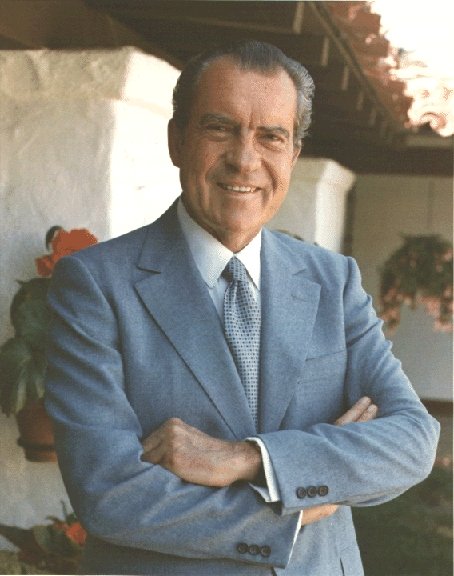
I decided to take a course about Richard Nixon this quarter taught by a former Nixon speech writer because I was eager to get a firsthand impression of the man and because ever since we watched All the Presidents Men in my high school journalism class, the Watergate burglary and subsequent coverup has fascinated me. Furthermore, Nixon as a person has remained something of an enigma to me. My impression before this course was that he did several bad things, but he had my sympathy because he was a man who achieved success not by winning popularity or looks contests but by working hard all his life.
As I began the course, I developed an even more sympathetic view towards Nixon. Some of the negative impressions I had of him were based on what I knew as his schmaltzy "Checkers speech" and his persistent investigation of former high-level State Department aide Alger Hiss. However, I began to understand through our readings in this course that Nixon's attempt to avail himself of accusations of campaign finance chicanery seemed justified since in fact, there appeared to be no evidence that he had done anything illegal. As for the Alger Hiss affair, it was eventually revealed that Hiss was acting as a spy against the government he worked for, so Nixon's hunch to investigate him seemed vindicated.
However, as we proceeded to study Nixon's career, my respect for him began to dwindle. I realized that even my own sense that he had such a difficult life was borne of Nixon's expressions of self-proclaimed hardships. Yes, Richard Nixon took some hard knocks in life, but, he seemed to use that as an excuse for his later indiscretions. For an idea of how another president publicly presented his difficult upbringing, one can look to Bill Clinton who grew up even poorer than Nixon but emphasized the hope that his life course signified. Unlike Nixon, who waxed kind of oddly at his final White House address that "my mother was a saint," Clinton seemed to have a more grounded and less self-validating view of his upbringing.
Furthermore, the fact that Richard Nixon never made a genuine expression of regret for his actions in the coverup of Watergate rankles me. His sense of those events, where he ordered the CIA to try to end the FBI investigation of the burglary and continued a massive effort at coverup therein, was that he never did anything that his "enemies" had not done, but as I wrote earlier and as others have pointed out, Nixon's corrupt acts far outnumbered his predecessors. There is evidence that he interfered in the 1968 Paris peace talks to end the war in Vietnam, that if true, means that he committed treason. He illegally bombed the country of Cambodia during that war, and even if he was not directly involved in the execution or ordering of the Watergate burglary, he ordered many other unethical and/or illegal actions be committed against Democrats.
Doing research for a final project on Nixon's relations with his successors has only hardened any sense I had that this man deserved our country's goodwill despite his transgressions. The conventional wisdom is that that "he mellowed and grew more philosophical" through his later years, but as this article suggests, he actually became more bitter in his obsession with getting Democrats. He and Clinton established a friendly relationship when Clinton came into office, and Clinton was the first president since Carter to invite Nixon to a public event at the White House. Until Nixon's death, they had relatively frequent phone calls with a good amount of personal exchange. However, Nixon thought that the Republicans should use suggestions that Clinton had been involved in an illegal real estate deal (of which he was later exonerated) to make him "pay the price" for what he felt was unfair targeting of himself over the years. Republicans must not "let [Whitewater] go down, must not let it sink," he said. Nixon called then-Senator Bob Dole to make sure aggressive questioners were placed on a Senate subcommittee looking into Whitewater. He also used his own personal understanding of Clinton to give Dole advice on the President's vulnerabilities (Nixon assumed Dole would be the 1996 nominee). Clinton for his part gave Nixon a gracious and some have suggested too generous eulogy at Nixon's funeral in April of 1994 where he said "May the day of judging President Nixon on anything less than his entire life and career come to a close."
Nixon's behavior towards Clinton, as I have come to learn, is characteristic Nixon and elicits a characteristic reaction about Nixon. When first reading about their relationship, my feelings warmed towards Nixon, as they had earlier in the course when reading about the misunderstandings around the Fund case and the Hiss case. I was taken in, as many have been, by the "New Nixon" posture. However, Nixon squandered any honorable gesture--as he always had--by allowing himself as usual to get caught up in his petty political vendettas and vortex of self-pity. Although I'm sympathetic to the fact that Nixon probably suffered from a psychological disease that made him depressed and angry, I think the revisionism on his character gives this small-minded man a lot more credit than is due.
Thursday, February 23, 2006
The trouble with elitism
I have developed a visceral distaste for the columns of Henry Bowles III and I'm starting to realize why: Bowles's arguments are premised on elitist platitudes that take a distrusting view towards the reasoning power of the majority of people. In an article on protests against military recruiters' presence at a campus job fair from January, Bowles criticizes the recruiters for being at a college campus for this reason:
Bowles goes onto suggest that there are better potential military recruits elsewhere:
The only semi-positive thing I can say about this article is that Bowles openly admits what a lot of university student supporters of the war in Iraq are thinking.
Otherwise, Bowles expresses a belief that humans are automatons equipped with zero ability to judge for themselves whether or not they want to be in the military. If the intelligent male joins the military, he will emerge brainwashed, Bowles seems to suggest, and therefore is himself devoid of any faculties for critical thinking. "Less intelligent people" will be susceptible to the same thing, but it does not really matter, because they have "far less to lose." Bowles first of all fails to explain what distinguishes the intelligent person from the less intelligent person if both are to be brainwashed in his view, but more dangerously suggests that there is some solid group of people in this world who are better equipped to serve in the army simply because they are worth less (one would imagine that the "intelligent and creative" people who Bowles refer to are from a class of people who could afford to go to private boarding schools as Bowles did). Such a viewpoint contradicts every ideal of a democratic society and reveals Bowles's elitist distrust of the individual's reasoning capacity on which such a society is premised.
In the article that I mentioned earlier about Jewish identity with Israel, Bowles again expresses his distrust of individual thought. He makes the baseless assertion that
"Jewish youths, particularly in the U.S., are so well-propagandized that they can hardly think critically on the issue." Of course, as letters to the Daily from today and yesterday emphasize, there is a strong Jewish dialogue on the subject of Israel. Just because Bowles has made no effort to connect with this dialogue does not mean it does not exist. What is notable about Bowles's assertion is again its complete distrust of the power of people to reason and truth-seek. By revealing such a strong suspicion of other humans and in conjunction with it such a strong belief in automatism, maybe Bowles is pointing to his own inability to understand discourse between humans as something other than a struggle between propoganda outlets.
....To keep the military away from our brightest students [because y]oung males are easily manipulated during the period of their lives when they exist outside the female domain, after the mother and before the wife. They are above all eager to demonstrate masculinity. With its promises of order, fraternity and cohesion, the military taps into this angst. A real tragedy occurs when a young man, susceptible to the military's appeal and nonetheless intelligent and creative, signs up to become cannon fodder.
Bowles goes onto suggest that there are better potential military recruits elsewhere:
Less intelligent people are better equipped for most military positions, and have far less to lose.
The only semi-positive thing I can say about this article is that Bowles openly admits what a lot of university student supporters of the war in Iraq are thinking.
Otherwise, Bowles expresses a belief that humans are automatons equipped with zero ability to judge for themselves whether or not they want to be in the military. If the intelligent male joins the military, he will emerge brainwashed, Bowles seems to suggest, and therefore is himself devoid of any faculties for critical thinking. "Less intelligent people" will be susceptible to the same thing, but it does not really matter, because they have "far less to lose." Bowles first of all fails to explain what distinguishes the intelligent person from the less intelligent person if both are to be brainwashed in his view, but more dangerously suggests that there is some solid group of people in this world who are better equipped to serve in the army simply because they are worth less (one would imagine that the "intelligent and creative" people who Bowles refer to are from a class of people who could afford to go to private boarding schools as Bowles did). Such a viewpoint contradicts every ideal of a democratic society and reveals Bowles's elitist distrust of the individual's reasoning capacity on which such a society is premised.
In the article that I mentioned earlier about Jewish identity with Israel, Bowles again expresses his distrust of individual thought. He makes the baseless assertion that
"Jewish youths, particularly in the U.S., are so well-propagandized that they can hardly think critically on the issue." Of course, as letters to the Daily from today and yesterday emphasize, there is a strong Jewish dialogue on the subject of Israel. Just because Bowles has made no effort to connect with this dialogue does not mean it does not exist. What is notable about Bowles's assertion is again its complete distrust of the power of people to reason and truth-seek. By revealing such a strong suspicion of other humans and in conjunction with it such a strong belief in automatism, maybe Bowles is pointing to his own inability to understand discourse between humans as something other than a struggle between propoganda outlets.
Wednesday, February 22, 2006
There have been many excellent responses to the sickening article I referenced yesterday by Henry Bowles the III, but I wanted to excerpt this one because it is the most humorous:
Traditionally, I am a fan of editorials that challenge conventional beliefs. That being said, Henry M Bowles III is far and away the worst columnist I have ever had the misfortune of reading.
It's reached the point that I no longer blame Bowles for his misguided, non-sensical rants. Rather, I blame myself for reading any article situated under the profile-picture of Bowles and his Barry Melrose mullet.
Henry M. Bowles III or "The Trifecta", has an admirable willingness to address hot topics. The problem is that his stance on said topics is always wrong. Completely wrong. How can one be wrong on an issue with no right answer? Simple: They can be shitty Henry M. Bowles "The Third." He's more of a bitch than a bitch.
Tuesday, February 21, 2006
Anti-Semitism in various guises
The past few weeks have been disappointing for those of us at Northwestern University who had hoped that Arthur Butz's most recent opportunistic attempt to get his Holocaust denial publicized would be largely ignored. To be honest, when I wrote this about three weeks ago, I was not anticipating that Butz would have such staying power in the campus news.
Why has Butz had such power? First, Northwestern's main newspaper, The Daily Northwestern made the absurd decision to solicit and publish an article by Butz. The Daily and a few students who wrote letters to the editor have been operating under the hopeless naivite that a man like Butz is equally as honest as actual Holocaust historians and that revisionistsof his stripe are unfairly persecuted for unpalatable views. On the contrary, as historian Deborah E. Lipstadt of Emerson University accounts in a column from yesterday's Daily, it has been Holocaust revisionists who have tried to persecute others for their views:
Why has Butz had such power? First, Northwestern's main newspaper, The Daily Northwestern made the absurd decision to solicit and publish an article by Butz. The Daily and a few students who wrote letters to the editor have been operating under the hopeless naivite that a man like Butz is equally as honest as actual Holocaust historians and that revisionistsof his stripe are unfairly persecuted for unpalatable views. On the contrary, as historian Deborah E. Lipstadt of Emerson University accounts in a column from yesterday's Daily, it has been Holocaust revisionists who have tried to persecute others for their views:
I say this with over six years of legal experience defending myself against David Irving, once the world’s leading Holocaust denier. He sued me for libel for calling him a Holocaust denier in one of my books. He waited until the book appeared in the United Kingdom where the burden of proof is on the defendant.The Daily's decision to publish Butz seemed premised on the belief that Butz's methods for supporting his views are within the paramaters of intellectual honesty. As Professor Lipstadt explained so well, revisionists like Butz do not operate within such parameters. Witness her legal struggle with revisionist David Irving:
Rather than face any legal obstacles, Irving freely repeated his — and by extension Butz’s — arguments in court. The world press reported on them daily. No one faced any legal obstacles. No one was hauled into court except me.
I was able to mount an aggressive defense thanks to a defense fund which raised $1.75 million dollars. We hired a “Dream Team” of historians to closely examine Irving’s claims about the Holocaust. They found his work to be a “tissue of lies.”
By the end of my ten-week trial Irving was left looking like the Court Jester. He had called the judge “Mein Fuhrer,” a telling slip. When asked by Richard Rampton, my barrister, how he could say Herman Goring “goggled” at a certain exchange, when there was absolutely no evidence that Goring was even at this meeting, Irving declared: “author’s license.”
Butz is guilty of this same dishonesty:
Butz, in his column, engages in linguistic tricks. He claims that Timothy Ryback wrote in the Wall Street Journal that “there is little forensic evidence proving homicidal intent” in the ruins of Auschwitz. Butz ignores another portion of Ryback’s comment regarding Auschwitz: “these heaps of dynamited concrete and twisted steel are not only historic artifacts but among the few remnants of untainted, forensic evidence of the Holocaust.”
Why do we not enter further into “debate” with him? Because debating people who deliberately mislead is like trying to nail a blob of jelly to the wall. There is no end to the matter. If they have no fidelity to the truth how can you debate them? They just make things up as it suits them.
Professor Lipstadt's words should be heeded. Unfortunately, in today's Daily, a student columnist has picked up where Butz left off--constructing an uninformed argument that reveals this student's latent belief in age-old anti-Semitic conspiracies of Jewish cabalism and. There's no need to explicate the article itself: the main point is the deeply troubling sanctioning of anti-Semitic views by a student newspaper with a misguided understanding of free expression.
Subscribe to:
Posts (Atom)

